(Posted May 2, 2021)
This is the second in a review of wines that were mentioned in the great book by Kermit Lynch, “Adventures on the Wine Route: A Wine Lover’s Tour of France.” Just a reminder – Lynch’s book is one of the most entertaining and informative books about wine you’ll ever read – highly recommended.
The second wine in our adventure is a white wine (I thought I’d mix it up since our first was red): Savenniéres from Château d’Épiré. Now if you’ll recall, wine number one in our series was from a domaine; this one is from a château. What is the difference, you may ask? I’ve discovered that the old Q&A column “Ask Dr. Vinny” from Wine Spectator is a great source of trivia about wine. According to Dr. Vinny,
Hundreds of wine brands out there have either “château” or “domaine” in their names (and a few even have both). Often they’re used interchangeably to refer to a place where wine is made. If you’re looking for a more nuanced answer, château is the French term for a country house or castle, and is most commonly used by the wineries of Bordeaux, while the term domaine, which refers to a territory or empire, is typically associated with the wineries of Burgundy. Remember, though, that in most countries there are no legal restrictions on the use of these terms, so there may not be an actual, physical “château” at all … much less a “domaine.”
A good basic description of Savenniéres comes from wine-searcher.com (there are so many great resources out there; this is one of the best for finding quick info on wines). According to wine-searcher:
Savenniéres is a highly respected white wine appellation of the Loire valley wine region of France. Located immediately southwest of the city of Angers, the parish of the same name falls within the wider Anjou district. The wines are made from the Chenin Blanc grape variety, the mainstay of Anjou and the central Loire.

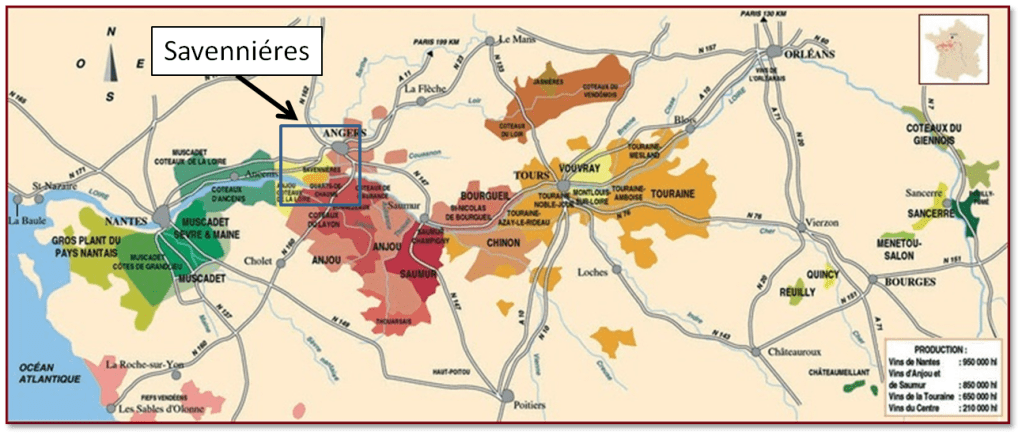
The World Atlas of Wine notes that the Loire River “is France’s longest, 629 miles (1,012km) from source to mouth, with wide variations in climate, soil, and tradition, and four or five key grape varieties… Loire wines are refreshing and invigorating, never massive, and rarely expensive. Over half are white, most of them based on a single grape variety [Chenin Blanc].” The Oxford Companion to Wine tells us that wine has been grown in the Loire Valley for roughly 2,000 years, “and was certainly well established by the 5th century.”
Now let’s talk a little about chenin blanc. This prodigious grape is apparently the source material for a lot of varietals, including Savenniéres. According to The Oxford Companion to Wine, chenin blanc is “probably the world’s most versatile grape variety, capable of producing some of the finest, longest-living sweet whites and a wide range of fine dry whites…. DNA profiling suggests relationships with a wide range of varieties including … sauvignon blanc… and even cabernet sauvignon.” So we owe a lot to this grape, including for our lovely Savenniéres.
What did Kermit Lynch have to say about Savenniéres? He really loved this area and its wines. His writing is lyrical:
Some tasters prefer the flintier dry white from Savenniéres, whose vineyards lie farther west toward the Atlantic, just past the city of Angers. The little highway between Tours and Angers runs along the banks of the Loire, which makes it difficult to concentrate on driving because rivers have personalities. While the Rhône is powerful and swift, the Loire glides along with a stately air and makes you feel as if you are in too much of a hurry… Had Cecil B. DeMille filmed the Second Coming, he would have selected the sky above the Loire as its setting… The area around Angers is called the Anjou…
Across the river, however, at Savenniéres, there is a small quantity of dry Pineau produced, and if it is vinified in the traditional manner, the results can be fantastically good. Having tasted a good one, one can develop a weakness for Savenniéres, and for the wine buyer who gives a damn about price, it presents one of those happy situations, a great wine, a noble wine, but little-known and consequently undervalued…
The stony soil here contains schist, which splits into layers quite conveniently for home builders. It also accounts for the nerve and firmness at the heart of Savenniéres wine, for its finesse and the attractive tinge of bitterness in its aftertaste. The aroma can be grandiosely expressive; there can be a vibrant steely freshness to it, and suggestions of honey, flowers, and unexpected fruit aromas like quince, pear, and red currant. If Savenniéres does not sound like the Chenin Blanc of California, neither does it taste anything like it…
A Château d’Épiré is two things. It is a wine, and it is a sixteenth-century château in the village of Épiré. The winery itself is lodged in the château’s twelfth-century chapel…
Savenniéres is a white that ages well… Not many are looking for the wine of Savenniéres. It was true in 1976, when I first tasted at Château d’Épiré, and it is still true today. The result is a truly superb dry white at a ridiculously low price.


So what was the verdict? Wine writers have had very distinct impressions about Savenniéres. As noted above, Kermit Lynch said it has a “vibrant steely freshness to it, and suggestions of honey, flowers, and unexpected fruit aromas like quince, pear, and red currant.” Eric Asimov in The New York Times said the Savenniéres he tasted (not from the same producer) was “intense and austere,” with hints of beeswax, citrus, and spice, and with a “mineral, saline quality,” with a “floral, honeysuckle edge… and a texture that is “paradoxically rich, viscous and wonderfully light.” (I love how descriptive wine writers can be.) The website wine-searcher.com says that its Savenniéres have hints of warm straw, beeswax, chamomile, minerality, and a honeyed tinge. These descriptors are so detailed and yet so varied that we weren’t sure what we were going to experience.
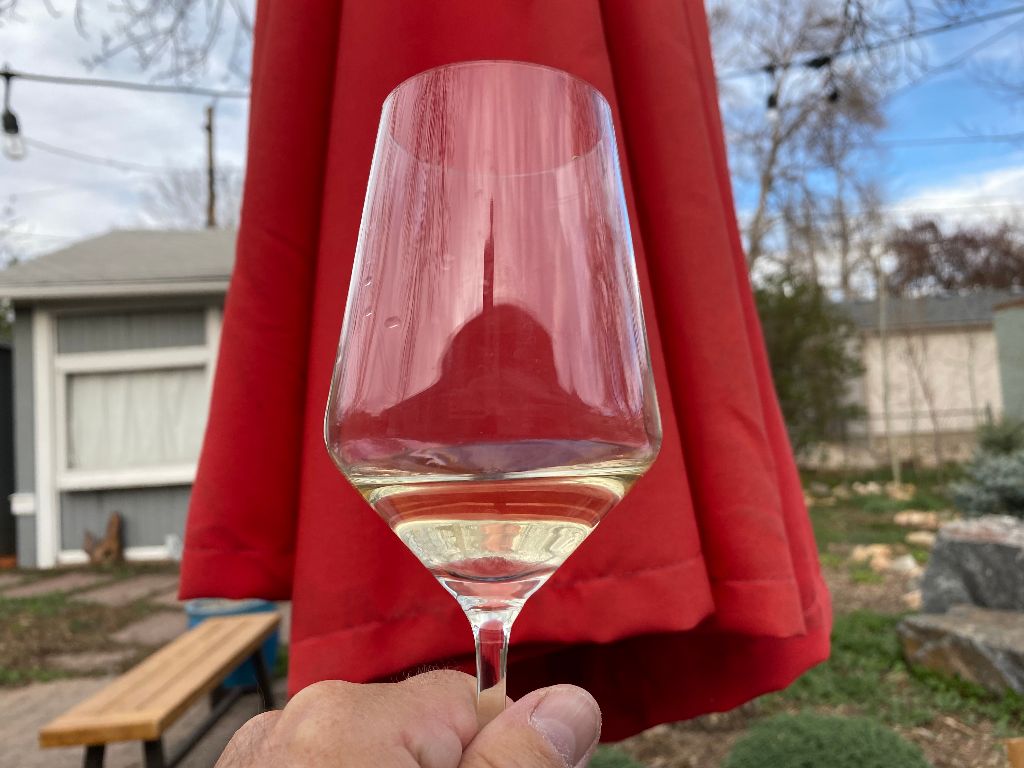
My guest wine tasters (Lisa, Bethany, and Sharon) and I spent a lot of time on this one. I didn’t reveal the wine experts’ impressions before we started so that our thoughts would be unbiased.
My take is that we are probably so used to the strong white wines of New Zealand and California that it took us a while to begin to appreciate the more delicate aromas and flavors of a nice dry French wine. A few of the aromas our group described included butter, pear and citrus. There was a hint of metal in the taste, a slightly bitter aftertaste, and hints or orange and pears. No one could identify currants.
Then we decided to try something different to help us in our quest for aromas and flavors. I was gifted something I had seen in some fancy-dancy tasting room in Provence – a wine aroma kit. Ours was from Le Nez du Vin (which I have it on good authority means “the nose of wine”). There are many sizes and types out there, but in short they have small bottles with liquids that have specific aromas – mine has 24 (12 white and 12 red) – that potentially can either train your nose or allow you to double-check aromas and flavors that others mention.
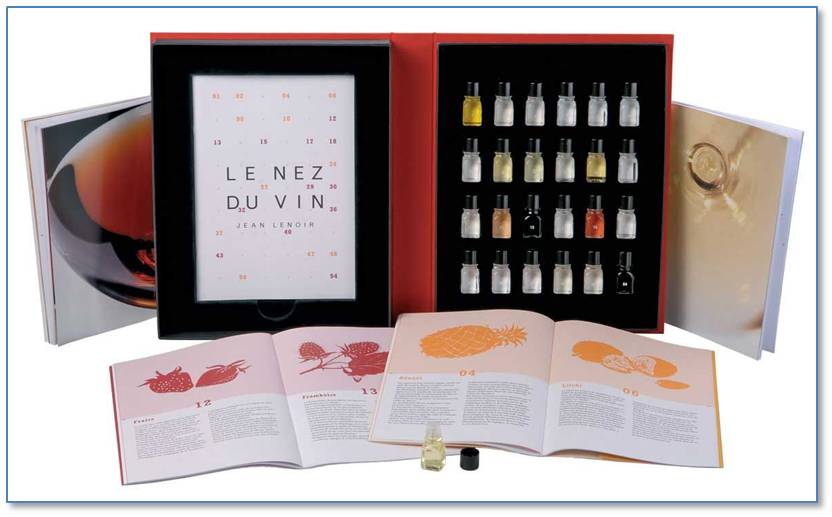
After sampling honey and pear scents and re-tasting the wine, we could definitely detect them much more strongly than before. But try as we might, we could not break through with currants. That seems to be an elusive taste for me and the others – but maybe we’ll focus on one in the future that has a much stronger currant vibe.
One other note – the bottle is really nice. I love the label (with a drawing of the Château) and its embossed glass. I’m a sucker for wine aesthetics!
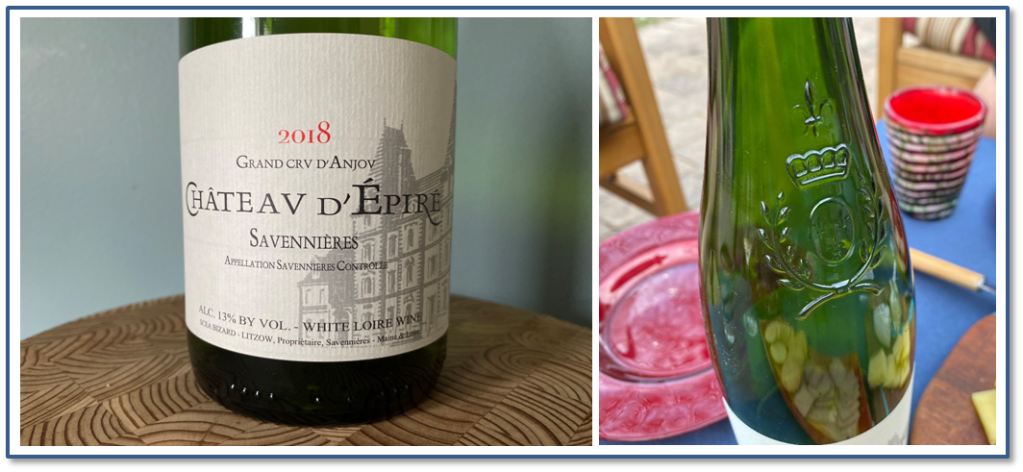
So what was the verdict? We all really liked this wine, but it didn’t stand out as an absolutely knock-your-socks off wine. I think we’ll need to try many more delicate white wines to see if we can train our noses and palates better to distinguish the subtleties that others note. One other note: we tasted some cheese (including a nice brie) with the wine, and its flavors became a little more intense. So on a scale of 1 to 10, we gave it an 8. I know it should probably have been rated higher, but we’re holding out the 9s and 10s for those that really, really impress us. We’ll keep looking (and tasting!).

Where can you get it? I ordered mine from wine.com, but you can also get it at kermitlynch.com; the price is around $30 (as Lynch mentioned, “a truly superb dry white at a ridiculously low price”). There are other Savenniéres out there in addition to Château d’Épiré. I found one (Domaine Baumard for $32) at my local Total, and I even found one (a 2013 from Domaine Eric Morgat, priced at $76) at my local neighborhood wine store (Pearl Wine Co.). If you look hard enough, you can find one, despite its small geographic origins.
Wine book recommendation: As you might notice, I mention several wine reference books. One that is indispensable is Jancis Robinson’s The Oxford Companion to Wine, literally an encyclopedia with entries on every conceivable wine topic, from appellation to geography to history and more – the best reference on wine I have found.

 The Cellar Door