(Posted May 26, 2021)
“Accept what life offers you and try to drink from every cup. All wines should be tasted; some should only be sipped, but with others, drink the whole bottle.”
― Paulo Coelho
This is the third in a review of wines that were mentioned in the great book by Kermit Lynch, Adventures on the Wine Route: A Wine Lover’s Tour of France. Once again a reminder – Lynch’s book is by far one of the most enjoyable and informative books about wine you’ll read. Lynch writes, “The Southern Rhône is a vast, productive, almost circle-shaped area… The most important city of the southern Rhône is Avignon, but the most important for the wine lover is Châteauneuf-du-Pape. In terms of worldwide renown and prestige, Châteauneuf-du-Pape is the greatest appellation in southern France….”
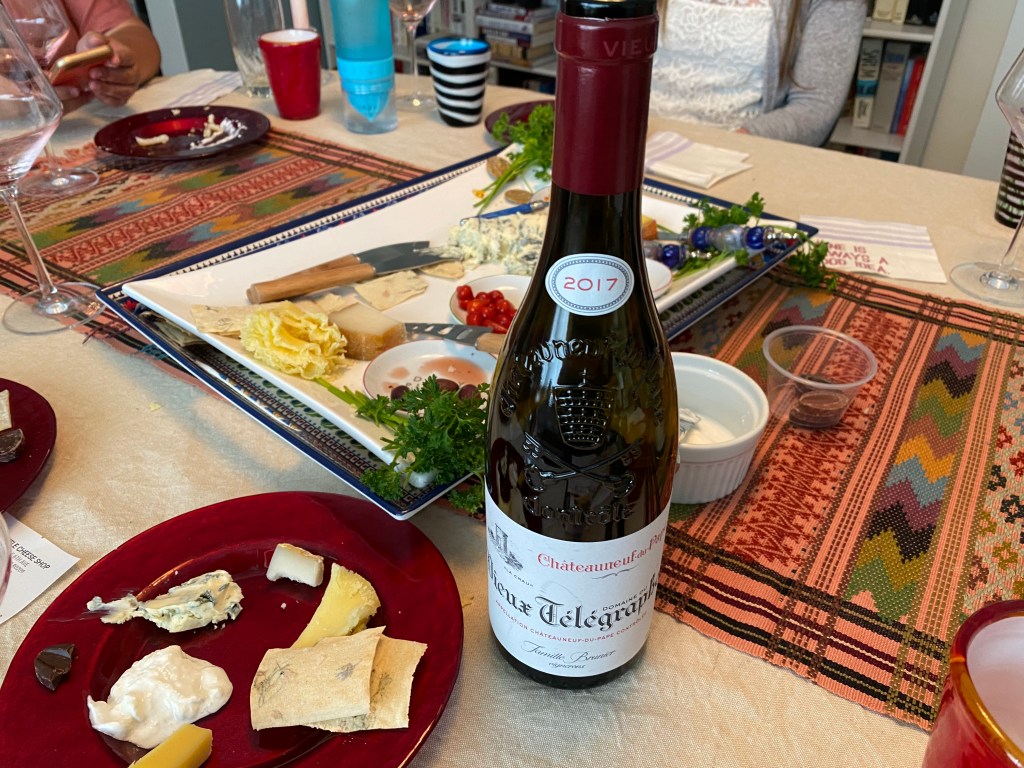
So the third wine in our adventure is a red wine: Châteauneuf-du-Pape from Domaine du Vieux Télégraphe in the southern Rhône valley of France. According to The Wine Cellar Insider: “Domaine du Vieux Telegraphe is one of the better known names in Chateauneuf du Pape. The Brunier family has been producing wines in the Southern Rhône Valley for over 100 years. Vieux Telegraphe was founded in 1898 by Hippolyte Brunier, the great, grandfather of the current owners.”
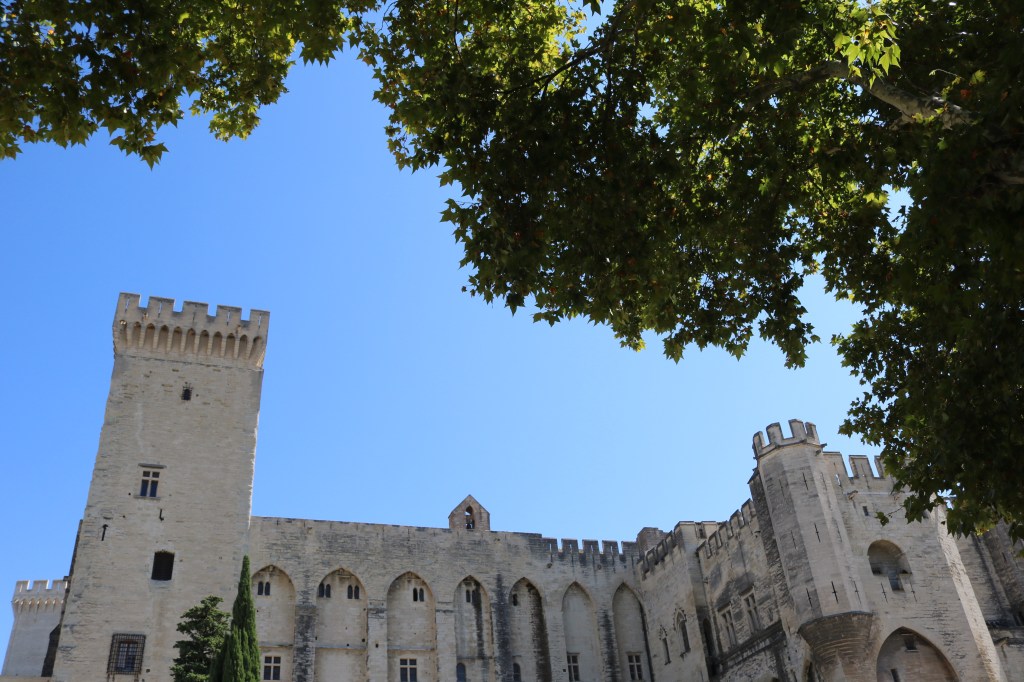
One of the most intriguing things about Châteauneuf-du-Pape is its name. According to my sources, it literally means “new house [or castle] of the Pope” (not to be confused with “find the Pope in the pizza” – look it up kids). It’s actually a town a few miles north of Avignon, but it’s named after a famous palace in Avignon that was built in the 1300s for Pope Clement V. He was also the Archbishop of Bordeaux, and due to some conflicts with the Knights Templar and other controversies, moved the papacy from Rome to Avignon in 1306. Though he died a few years later, the papacy remained in Avignon for 70 years. The castle (called the Palais des Papes) is magnificent and remains a tourist attraction to this day. From what I have read, viticulture in the region took off during Clement’s reign, especially in the area about five miles north of Avignon, now home to the small town of Châteauneuf-du-Pape, the location of the Pope’s summer quarters.

More about Châteauneuf-du-Pape: Most sources were effusive about Châteauneuf-du-Pape and the region where it’s grown. The Oxford Companion to Wine called it “the most important, and variable, appellation in the southern Rhône in terms of quality, producing mainly rich, spicy, full-bodied red wines which can be some of the most alluring expressions of warm-climate viticulture,” but noted that it “can also be either impossibly tannic or disappointingly jammy.” Now there’s an interesting word for wine – jammy!
It went on to say, “The Châteauneuf-du-Pape grape par excellence is Grenache and conversely Châteauneuf-du-Pape is its finest expression in France. Grenache dominates plantings in the Châteauneuf-du-Pape vineyards, and on their impoverished soils…” It also notes that Mourvedre is “an increasingly popular ingredient;” we learned about Mourvedre in our first outing with the lovely Bandol in nearby Provence.
The World Atlas of Wine says: “Châteauneuf-du-Pape the place is no more than a stony village in [the] arid, aromatic Provençal countryside, dominated by a ruined papal summer palace. The wine that bears its imposing name, though, is the proud standard-bearer for the dynamic southern Rhône, making France’s most potent, and some of its most individualistic, wines… Châteauneuf-du-Pape is unusual in its cocktail of as many as 18 permitted varieties…”
And of course you can’t go wrong with an embossed bottle – this time with a papal tiara placed above the keys of St. Peter with the inscription: “Châteauneuf-du-Pape contrôlé” written in Gothic letters. Every Châteauneuf-du-Pape apparently has this same bottle regardless of domaine.
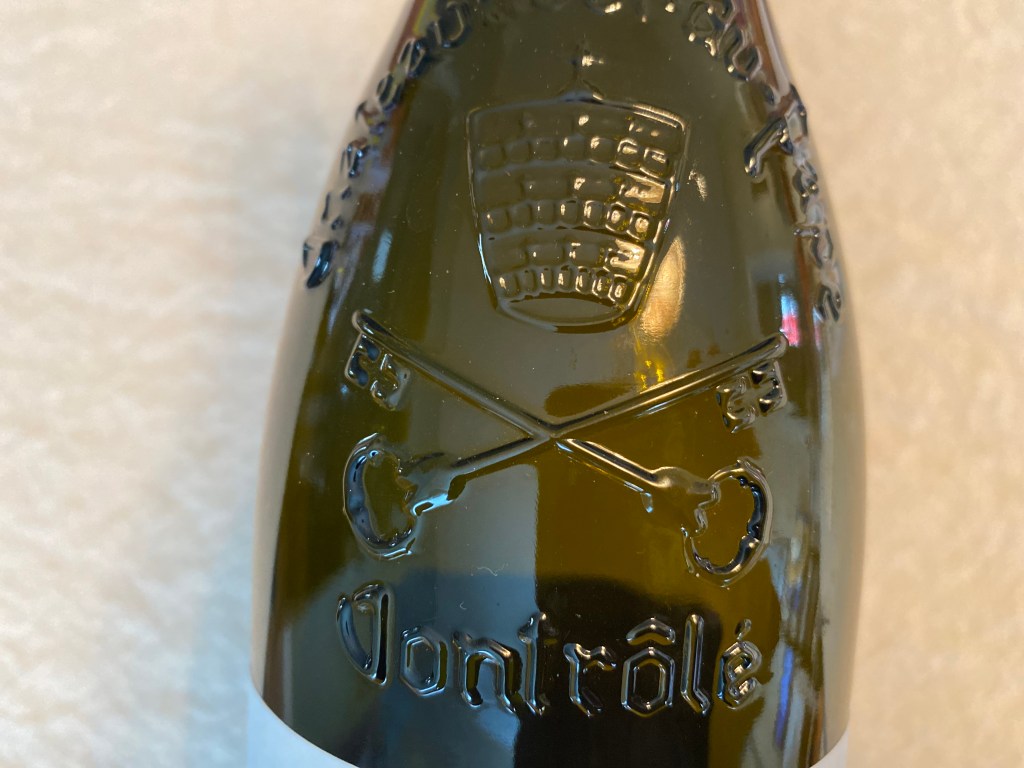

What did Kermit Lynch have to say about Châteauneuf-du-Pape in general and Domaine du Vieux Télégraphe in particular?“Vieux Télégraphe’s vines are planted on a very privileged site. Thanks to this site, their vinification, and their consistency, it is one of the two or three finest domaines producing Châteauneuf-du-Pape today… Henri Brunier of Vieux Télégraphe agrees that the vineyard site is of supreme importance. The source of his wine’s quality, he says, is his stony terrain, situated on the highest ridge in the Châteauneuf-du-Pape appellation. Because of the superior elevation, it was on this ridge that a telegraph tower was constructed in the eighteenth century, one of the relay points for communications between Paris and Marseilles. The crumbling stone ruin of this tower gave Vieux Télégraphe its name, and there is a rendering of it on the domaine’s label… Experienced tasters in the area recognize a Vieux Télégraphe by its expression of pierre à feu, or gunflint. A great Châteauneuf-du-Pape tastes almost as if it had been filtered through the stones, and indeed rainwater is filtered by this thick stone layer before it reaches the underlying soil which nourishes the plants….
“Châteauneuf-du-Pape reigns upon the throne of the wine aristocracy of the southern Rhône. Drinking a great one is an event.”
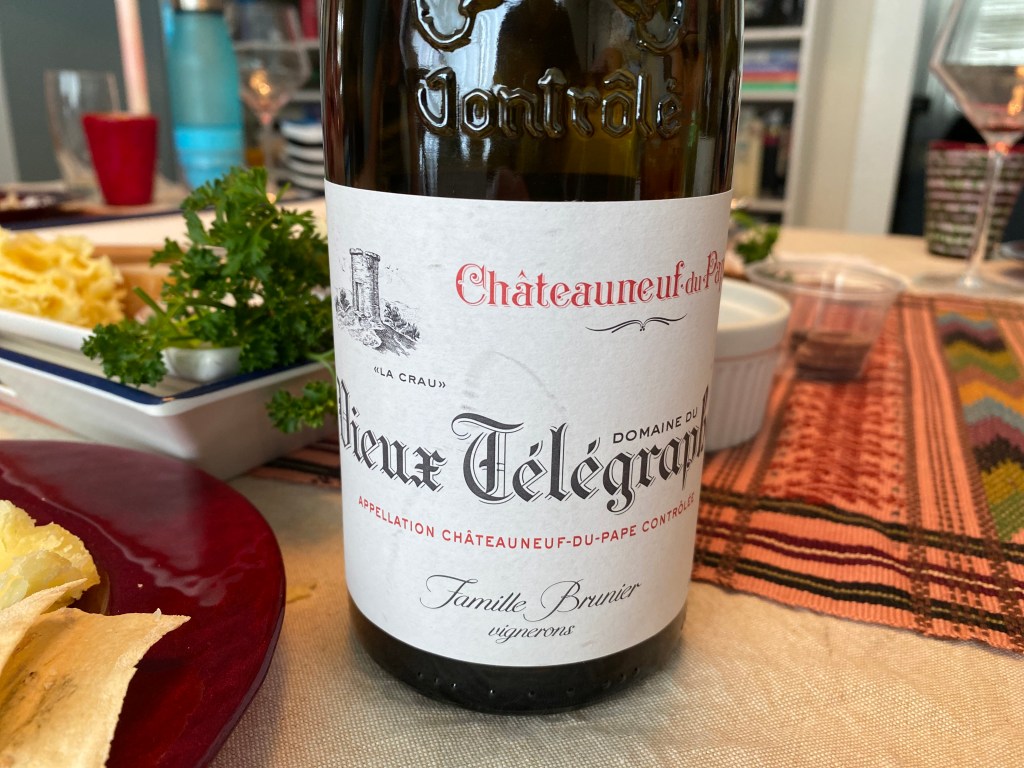
So what was the verdict? The words used to describe Châteauneuf-du-Pape focus on strength and flavor. Wine Searcher talks about the Grenache characteristics of “juicy with jammy [there’s that word again!] red-fruit and black-cherry flavors.” Adding syrah “brings structure and spiced black-fruit notes to the blend.” The Wine Bible says, “These are penetrating, dense, sassy wines that can come at you with a dagger of earthy, gamy flavors. They have a wildness to them, a fascinating edge of tar, leather, and rough stone.” Sassy!
Based on all this adulation, my tasting partners this time – Lisa, Jason, Chelsea, Bethany, and Taylor – were expecting to be blown away.
But … we weren’t. Maybe it was the vintage (2017). Wine Folly noted that the Châteauneuf-du-Pape from that year was “good” (compared with “exceptional” from some other years) because it was the “smallest vintage in 40 years… Extremely difficult harvest due to drought.”
Regardless, we liked it… but we didn’t love it. Again, maybe our California-familiar palates just haven’t gotten used to Old World reds just yet. But we did observe similar aromas and tastes that were written about – chocolate, dark cherry, raspberry, spices, and black pepper. It definitely got better as it decanted more – I should have decanted it for longer, I think. And it definitely paired well with chocolate – which seemed to get rid of tannins and bitterness – and cheese (The Wine Bible noted that Châteauneuf-du-Pape was “made for fromage”). It had relatively high alcohol content (14.5%), moderate legs (or “drippy things” as one of our tasters noted), was somewhat on the dry side, had medium-to-high-acidity and medium-to-full body, and a really nice dark red-purple color.
Overall, our ratings ranged from 6 to 8 (on a scale of 1 to 10), averaging right at 7. This was still very good, but a long way from the “perfect” wine that would rate a 10 (I’m not convinced it exists).

For comparison, we also opened a bottle of Clos Saint Michel Châteauneuf-du-Pape. This one was much lighter, less dense, and a little more fruity than the Vieux Télégraphe.
I just want to reiterate: we liked these wines. They were really good (especially the Vieux Télégraphe), so I would highly recommend them, especially after being decanted, and especially with cheese and chocolate!
Where can you get it? We tried the “La Crau” version of Vieux Télégraphe, available at Total for around $100. There is another lower-priced iteration (“Telegramme”) also available at Total for around $45. The Clos Saint Michel we tried is also available at Total for around $45.
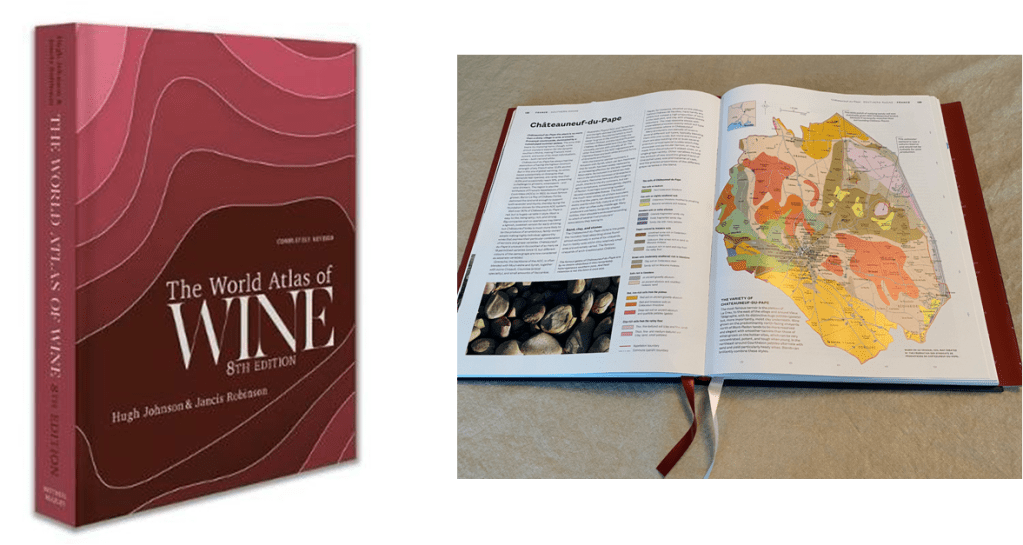
Wine book recommendation: To maintain the early trend of focusing on good all-around references, you can’t go wrong with The World Atlas of Wine, by Hugh Johnson and Jancis Robinson (the latter was also the primary editor of The Oxford Companion to Wine). This one is what it says it is – an atlas, full of great – and beautiful – maps, geographic and soil details, and lots of history.
 The Cellar Door
Best blog yet! 🍷
Lisa A. Goodbee, P.E.
lisa@goodbeeassoc.com
http://www.goodbeeassoc.com
LikeLike