(Posted July 2, 2021)
“Wine is one of the most civilized things in the world and one of the most natural things of the world that has been brought to the greatest perfection, and it offers a greater range for enjoyment and appreciation than, possibly, any other purely sensory thing.”
― Ernest Hemingway
This is the fifth in a review of wines that were mentioned in the great book by Kermit Lynch, Adventures on the Wine Route: A Wine Lover’s Tour of France. Once again a reminder – Lynch’s book is by far one of the most enjoyable and informative books about wine you’ll read.
About our fifth wine and its provenance, Lynch writes: “The northern Rhône consists of a long, narrow, stingy stretch of vineyards along the river between Vienne and Valence…. By contrast, the southern Rhône is a vast, productive, almost circle-shaped area, and here one finds the vineyards of Châteauneuf-du-Pape [which we reviewed earlier], Gigondas,… and countless others…. There is both an official and unofficial hierarchy of appellations in the southern Rhône. Officially, Châteauneuf-du-Pape is not ranked above Lirac, Tavel, or Gigondas. The four have a right to stand on their name alone.”
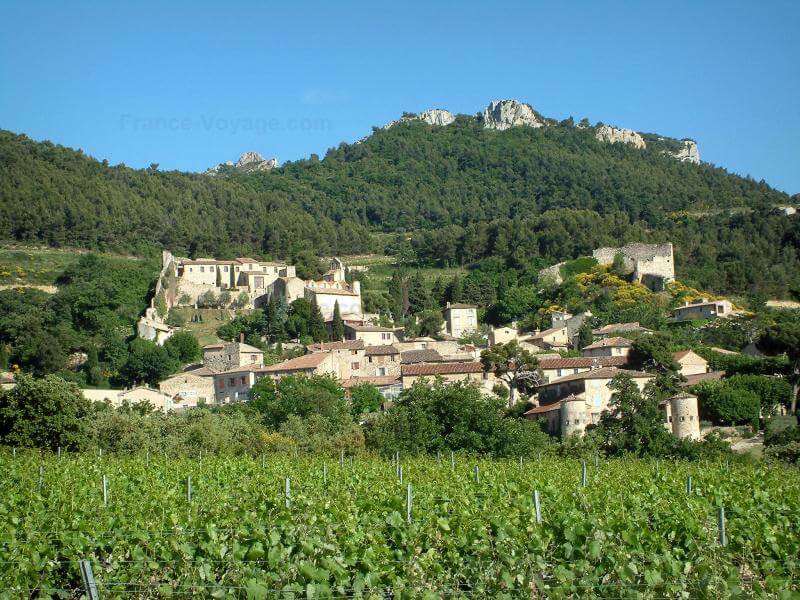
As with other wines in the Rhône, Gigondas is both a village and a wine. According to Lynch, “Artifacts reveal that the Romans, smart fellows, enjoyed a good quantity of wine at Gigondas. The name is supposedly from Jocanditus, which means “merry or joyous city.” While the village as it stands is not that ancient, it is old enough. With tile roofs and cavernlike dwellings – the doorways appear to lead right into the hillside – it is an altogether idyllic, surprisingly lazy, secluded spot. What a wonderful place for a wine merchant to retire, surrounded by vines, olive and fruit trees, wild herbs, ruins of the medieval fortified city on the hillside, and a population of only 750 with whom to share it all.”
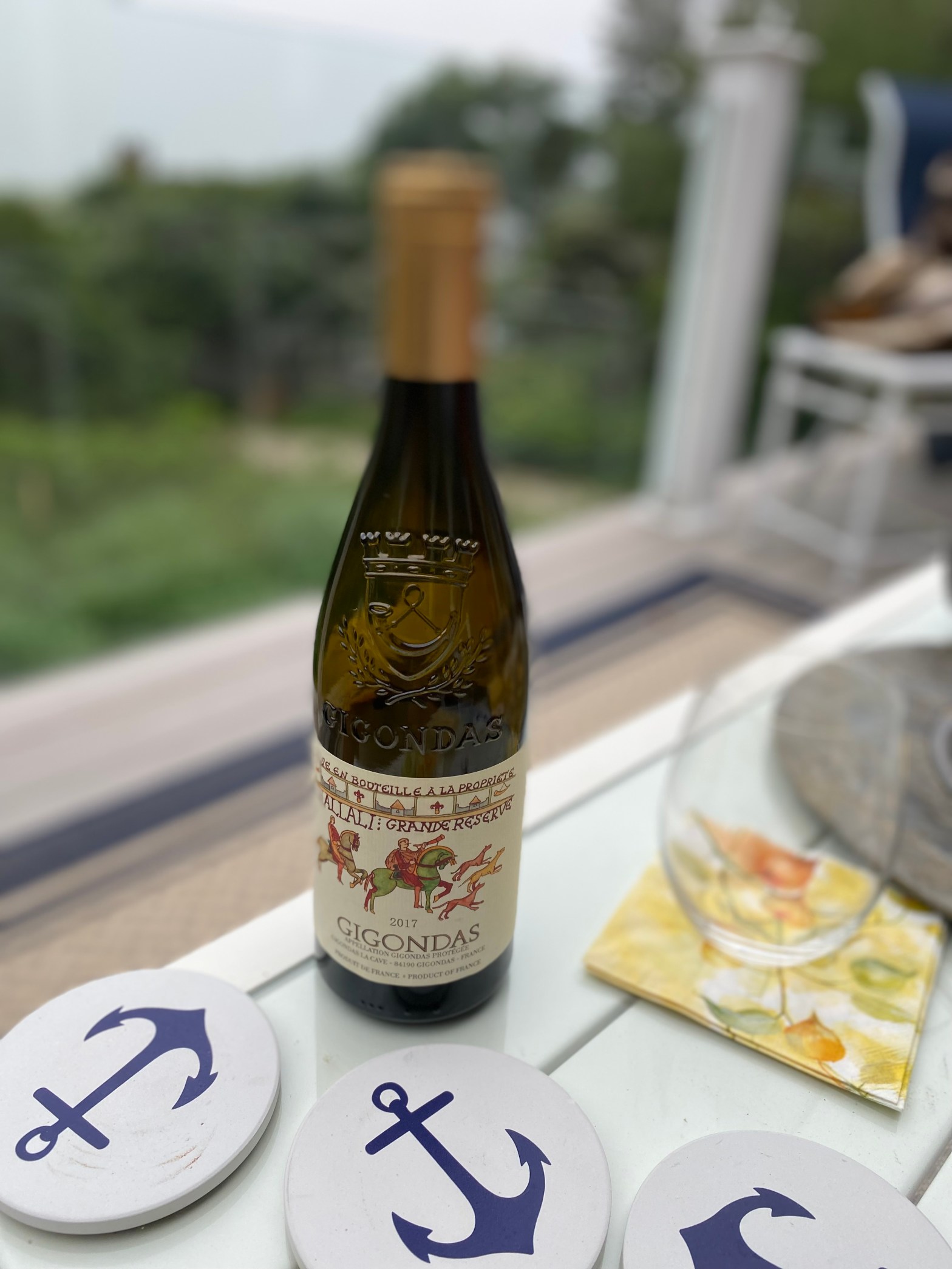
So the fifth wine in our adventure is a wonderful red from the southern Rhône: L’Hallali Grande Reserve Gigondas from Gigondas la Cave.
First, a little orientation. The Rhône valley is approximately 250 miles long in the southeast portion of France, flowing from the Swiss border to the Mediterranean. It is divided into two wine regions, the smaller north and the larger south, where Gigondas is located. According to The World Atlas of Wine, “This [southern] region is renowned for warming, ripely welcoming, and rarely expensive wines of all three colours, but mostly red.” The Oxford Companion to Wine tell us that wine has been produced in the area since the 1st century, but after the Romans left there is little history of wine until the Middle Ages. Gigondas is described as a “good-value red … remarkably similar to … Châteauneuf-du-Pape, with the benefit of higher elevations and more limestone.” The World Atlas of Wine notes that “Gigondas was the first [in the southern Rhône] to win its own appellation back in 1971, and the quality of its tight-knit reds can rival that of Châteauneuf-du-Pape itself…. Thanks to elevation, and more calcareous [chalky or containing limestone] soils, Gigondas tends to be more aromatic and often rather fresher wine than Châteauneuf.” Wow, there is a lot of Châteauneuf envy going on here!

Openingabottle.com tells us that the commune of Gigondas “is situated in the Provence-Alpes-Côtes d’Azur region of southern France, nestled beneath a jagged, fin-like limestone escarpment called Dentelles [apparently “lace,” not “teeth”!] de Montmirail. The limestone from this mountain ridge has eroded over time, traveling downslope in alluvial deposits, creating a unique soil that fosters flavorful, and nuanced Grenache grapes.”

Our winery, Gigondas la Cave, was created in 1956 and is a conglomeration of several vineyards in the Gigondas area and, according to its website, “manages the wine made from the grapes of its cooperators. It carries out the operations of winemaking, aging, storage, packaging, and sale together.” The L’Hallali is one of several wines that the winery produces and distributes. The word “hallali” means a “huntsman’s bugle call” – which explains the label.
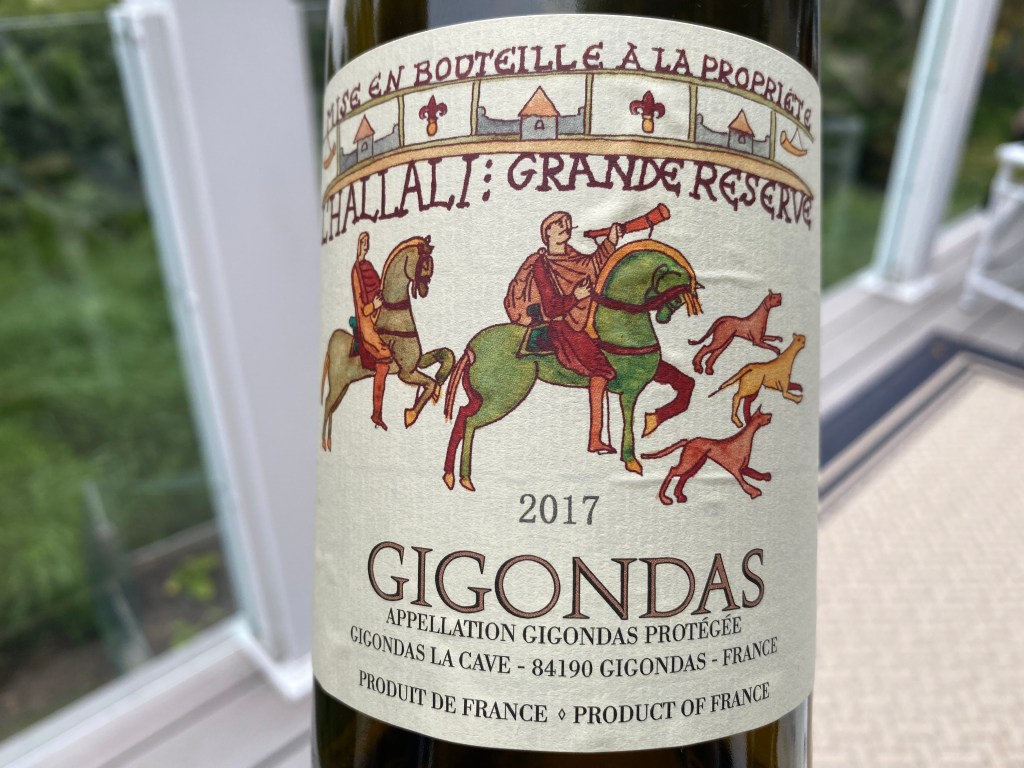
How I found this particular wine: After reading Adventures on the Wine Route, I made a list of all the wines (and domaines) that Lynch mentions. After searching online, I discovered that many of the domaines that Lynch explored are no longer in business (the book was written in 1988, after all). Lynch was especially smitten with Faraud’s Gigondas wine, and he tells a long story of trying to convince “old man Faraud” to let him (Lynch) buy and export his wine. Faraud’s wine is still sold today under the name Domaine du Cayron, and that vintage is well regarded. I also found other well-known Gigondas in my internet searches.
However, I found myself in Cape Cod visiting some old friends when I proposed a wine tasting for this blog. I visited a few small liquor stores – the town I was in, Chatham, did not have large retail alcohol establishments – and did not find any of the wines on my list. But in one store (Cranberry Liquors in the nearby town of Harwich Port) I stumbled on this Gigondas. With no other options in sight, I chose it for our tastings, and I was glad I did.
So what were we to expect? Most reviewers, as mentioned earlier, categorize Gigondas as a good, tasty, lower-priced alternative to the nearby and highly-acclaimed Châteauneuf-du-Pape. The Wine Bible tells us that “By law, the [Gigondas] reds must be no more than 80 percent Grenache, with no less than 15 percent syrah and/or mourvedre blended in.” The Bible goes on to say that Gigondas has “explosive raspberry, leather, and spice aromas and flavors and chewy textures.” Hmmm, that may be the first time I’ve come across “chewy” but okay. The Bible lyrically tells us, “To drink Gigondas is to go back to a time when great red wines were muscular and rough – a time before winemakers knew how to soften up wine and give it polish.” Wow, these are some fairly tough descriptors!
Openingabottle.com tells us that Gigondas has two notes that come to the forefront: “an aroma of licorice and a lingering finish that recalls orange peel.” Eric Asimov of The New York Times reviewed a Gigondas in 2015 and says it is “ripe and fruity” and “had almost a liqueur-like quality, interwoven with a savory, herbal, evergreen aroma. On the palate, the wine was earthy and mineral, well balanced with smooth tannins. With time, the herbal complexity grew and expanded.”
My guest tasters, Joe and Barbara, noted similar aromas and flavors. Joe noticed a very strong fruit aroma similar to prunes. Barbara and I were taken with the wine’s earthy flavors and aromas, almost forest-like, with strong spices and, yes, evergreen aromas and tastes. And it definitely got more flavorful as it decanted longer.
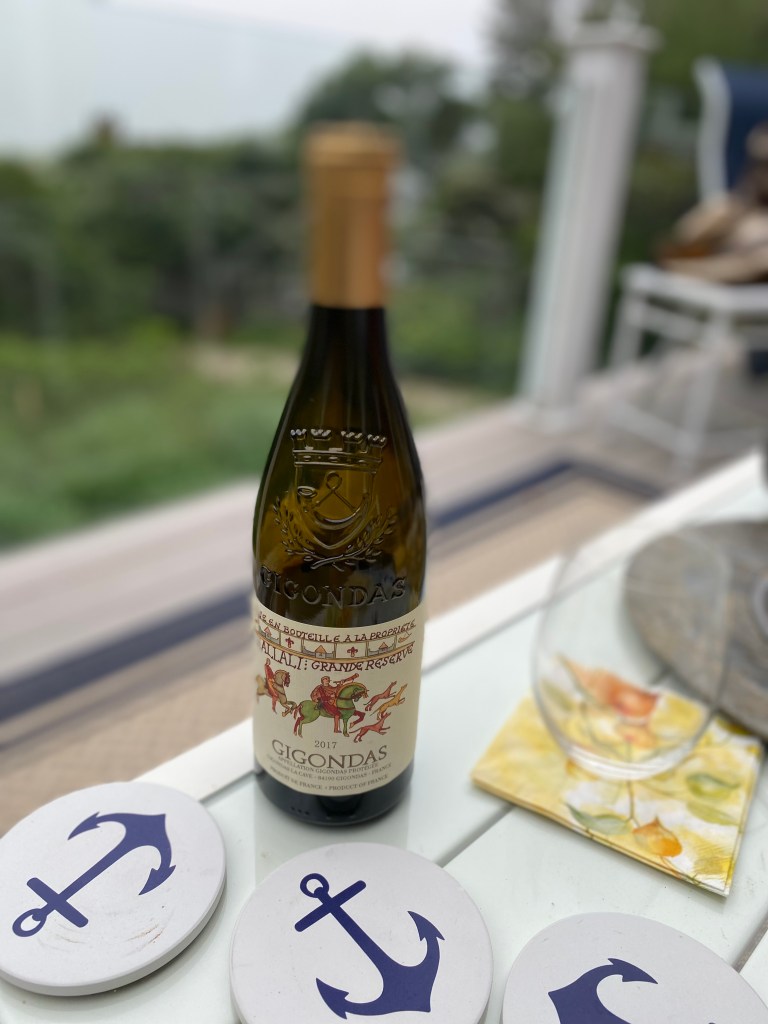
And similar to the Châteauneuf-du-Pape, the bottle has a cool embossed crest. I’m a sucker for great labels and embossed bottles!

So what was the verdict? You may have noticed that in previous reviews, I ask my guest tasters to rate wines on a scale of 1 to 10, with 10 being the most perfect wine imaginable. I started out on that path, but Barbara said it was hard for her to do that because, for her, the experience of drinking wine is as important as searching for its specific quality “ranking.” In this case, we were sitting on a balcony overlooking Nantucket Sound, with ocean breezes in our face and the pink sky of sunset overtaking us above. Sharing the wine in that moment with old and dear friends was the prize, not some subjective wine-tasting ranking.
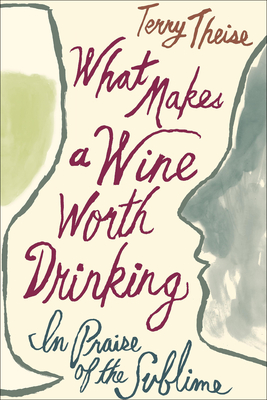
Oddly enough, I had just been reading What Makes a Wine Worth Drinking: In Praise of the Sublime by Terry Theise. I characterize his book as a sort of “Zen and the Art of Drinking Wine”, as Theise is not a traditional wine critic. He tells us,
The finest wines are distinctive; they display their origins with the greatest possible clarity and detail. This glimpse of place is part of the spirit of place, and when we let ourselves respond to that spirit, it helps us locate ourselves and our lives…. Your “palate” is only partly your sensory grasp of flavor; it is more saliently the entire sensibility you bring to aesthetic experience.
In other words, we spend too much time looking for the specific words to link to wine aromas and tastes and not enough time just enjoying the experience – letting wine take us back and forth in time and to places we’ve been and people we love. We can taste a wine and imagine its roots, its origins, the sun and the water that nourished it, the people who cared for it and made it. Or we can let it remind us of the place we were when we tasted it and the people we were with – in this case, overlooking Nantucket Sound with my dearest of friends, Joe and Barbara.
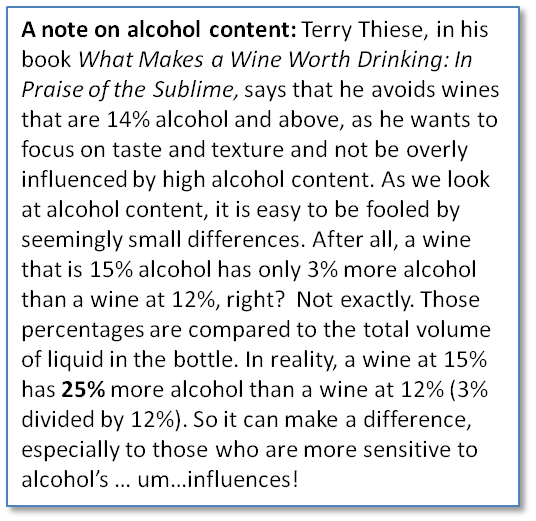
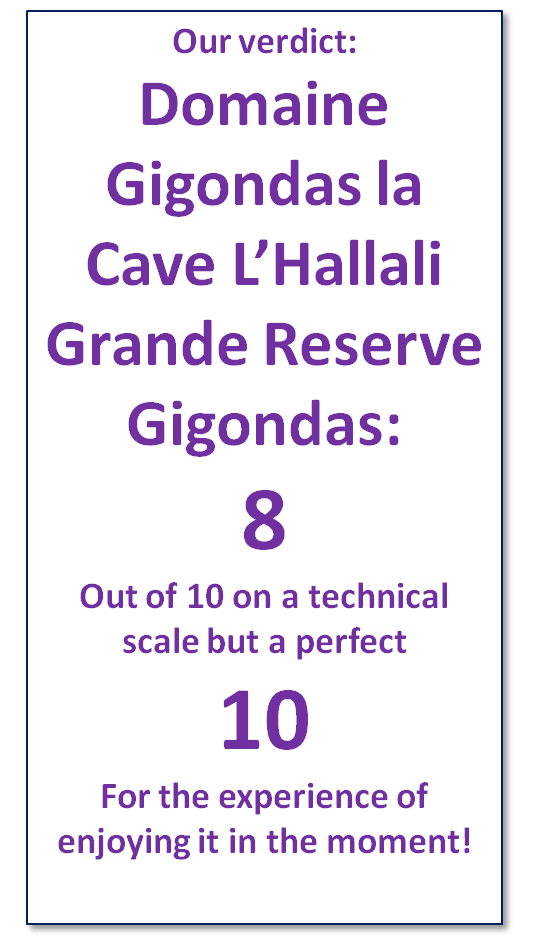
So….. to fulfill my mission, I’ll give this Gigondas my “technical” ranking of 8 on a scale of 10. It was wonderful, earthy, full, ripe, and, yes, chewy, muscular, and rough (it also had a high alcohol content – 15%!). But on the experience scale of enjoying it in the moment, it was a 10!
Where can you get it? You can find Gigondas from several producers on several wine sites ranging from $20 to $35. This particular Gigondas can be found at Vivino for $25.
Wine book recommendation: To continue the “zen” trend, I highly recommend What Makes a Wine Worth Drinking: In Praise of the Sublime by Terry Theise. He focuses on the essence and experience of wine and, as one of the blurbs says, “It is the story of one man’s complex love affair with wine, fraught with beauty, sadness, poignancy, wonderment, perplexity, and finally, surrender.” Highly recommended!
 The Cellar Door