(Posted August 17, 2021)
“It’s a smile, it’s a kiss, it’s a sip of wine … it’s summertime!”
― Kenny Chesney
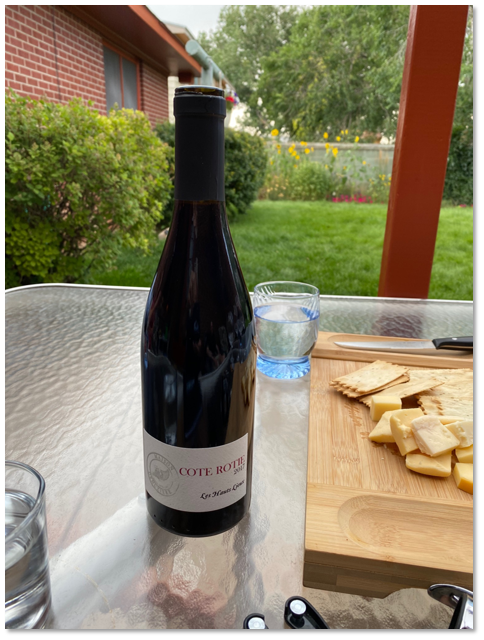
This is the seventh in a review of wines that were mentioned in the great book by Kermit Lynch, Adventures on the Wine Route: A Wine Lover’s Tour of France. Once again a reminder – Lynch’s book is by far one of the most enjoyable and informative books about wine you’ll read.
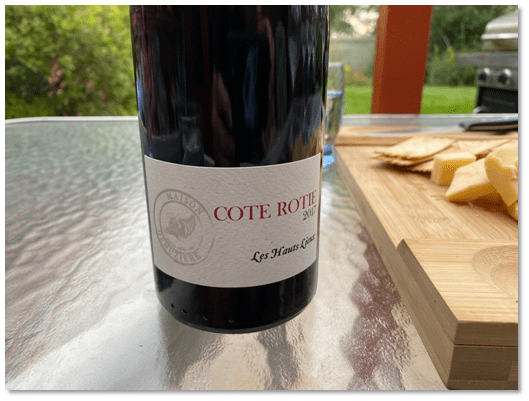
The seventh wine in our adventure is a delightful red from the northern Rhône valley: a Côte Rôtie from Maison Denuziere. Ours is labeled “Les hauts lieux” which means “the high places” – more on that later.
About our seventh wine, Lynch writes lovingly about the geography of the area:
“Sorting out the Rhône is not difficult…. The two regions, north and south, are about an hour’s drive apart. There are profound differences between the two in terms of landscape, soil, climate, and grape varieties employed … and finally in the taste of the wines themselves.”

“South of Lyons (the French spell it Lyon), a few hundred yards past the limits of the old Roman city of Vienne, the vineyards of the northern Rhône commence in grand fashion with the Côte Rôtie, or ‘roasted hill.’ For the great appellations of the north, it is best to keep in mind two dominating factors: Syrah, which is the only red grape permitted, and steep, because the vines are planted on dramatic terraced hillsides that rise from the narrow valley floor.”
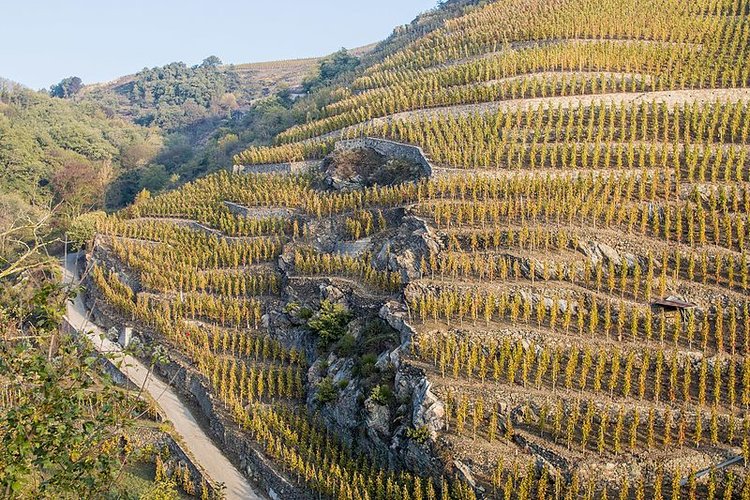
“Walking the Côte Rôtie vineyards, one is impressed by the difficulty of climbing such steep hills…. An unreal landscape, it sticks in the mind like the volcanic Kona coast of Hawaii or the surface of the moon. It is totally unprotected from the elements. I have been there in the summer when the stones are too hot to touch…. The French cultivated this ridiculously stony site, this nearly impossible surface, because it gives a special character to the wine…. [The stones] look like Sierra riverbed stones and were formed by the same geological process. They are glacial deposits, shattered and shaped by the weight and crunch of the glacier’s movement, then rounded and polished by the flow of water as the ice melted. One tastes the influence of the stones in the wine.”

Wine Searcher says that “the Côte Rôtie is the Rhône Valley’s northernmost appellation, and one of its smallest.” Most references give Côte Rôtie glowing reviews. The Wine Bible says that they are “some of the most thrilling wines of the Rhône…. There are slightly less than 500 acres of Côte Rôtie vineyards, the best of which are on precipitous granite slopes with grades of up to 60 degrees, facing due south. On these hillsides the grapes do not exactly roast, but they do sunbathe.” The Oxford Companion to Wine tells us that Côte Rôtie is “one of the most exciting, if geographically limited, red wine appellations in France.” Many references wrote of the area’s wine history going back to Roman times – I’d highly recommend pursuing that story in more detail if you’re interested.
Terroirwines.us gives us some history of Denuziere winery specifically:
“Maison J. Denuziere has its origins in 1876, when Joanny Paret began delivering Condrieu wines by wagonload to customers in the surrounding villages. Vins Paret succeded and grew into a respected negociant firm, renamed Vins Denuziere by Joanny’s son-in-law Pierre Denuziere. After a sale in the early 2000’s, the focus was changed from negociant work to wine production and towards becoming a full-fledged Domaine, with a focus on high-quality wines from select appellations in the northern Rhone. Today, the Domaine’s own vineyards are sustainably-farmed as Denuziere moves its production further towards environmentally sound practices, and produces critically-acclaimed and compelling Northern Rhone wines.“
So what were we to expect? Kermit Lynch’s book says that “Traditional Côte Rôtie does not have a thick, heavy quality…. a description from 1786 [!] says Côte Rôtie is ‘un vin flatteur et fort delicat’ (a seductive, highly delicate wine).” Other reviews follow along those lines.
The Wine Bible tells us that Côte Rôtie wines are “dramatic wines with incisive, earthy, and gamy flavors. Pepper seems to pace back and forth in the glass like a caged animal.” Now that’s some imagery! The Oxford Companion to Wine says that Côte Rôtie can be “relatively light and fresh with a particularly haunting savoury perfume.” Jebdunnuck.com says “This deep purple-colored beauty offers a classic perfume of raspberries, spring flowers, violets, and sappy herbs. With beautiful purity of fruit, no hard edges, and good freshness…” Sappy herbs – I like that!
But after that, things get a little wonky….
Wine Searcher says that “Côte Rôtie wines are renowned for being elegant and finely structured, with complex aromas typical of the local terroir and of the Syrah grape variety from which they are made. As is the case in Crozes-Hermitage [also made in the Rhone valley], an addition of up to 20 percent of the white variety Viognier is permitted under the appellation law, and producers take advantage of this to bring elegance and balance to their wines.” Vins-Rhone.com tells us that “The prestigious Côte-Rôtie cru is made from Syrah, which when blended with Viognier, shows incredible elegance of aroma and extraordinarily fine tannins. Its superb ruby red colour, its complex, elegant nose of spice, red and black berry fruit and violets, its full body and impeccable pedigree make this a highly sought-after wine.
The review from Openingabottle.com gets really interesting: “As I poured it into the decanter and buried my nose into a glass of it, I immediately felt like this wine was unlike anything I’d tried before. It was intensely fragrant, but the aromas were equal parts familiar and strange. Bacon and violets? Flint and smoked wood? And what kind of fruit does this recall? Plums? Figs? It may have been that the wine needed more years of development to become something exceptional.”
Bacon? Okay, that’s a first. Perhaps when blended with Viognier? (Note: our wine was 100% Syrah.)
Eric Asimov’s column in The New York Times in November 2012 talks about more meat (!): “Nowadays, rather than a perfumed delicacy, a bottle of Côte-Rôtie is more likely to be a powerhouse, big and fruity and, especially when young, with the woody patina that comes from aging in new oak barrels.” The wine he tasted (admittedly probably older and more expensive than ours) was “dominated by oak, yet I could detect a pleasing savory scent of roasted meat underneath the sweet veneer… with the aroma of violets, bright fruit and bacon…. Please forgive the gushing, but what a brilliant wine: aromatically beautiful, complex and graceful, with flavors that lingered long after I swallowed. This wine was not an expression of power, but of elegance and finesse, and it had many years left to it. If wines could still be made like this, why aren’t they? It had an alluring aroma of licorice and smoked meat, but even at almost 30 years of age [ours was a 2017], oak tannins were still apparent on the palate.”
I was so intrigued by all the meat references. Bacon!

What was our experience: I did not prime our guest tasters (Sharon, Susie, Roy, Rick, and Murf) with any pre-disposed notions of meat (!) – or anything else for that matter. But their observations were consistent overall with the previous reviews. One of our tasters said the Côte Rôtie was “austere,” in this case compared with the bold California Cabernets most of us are used to drinking. It was definitely “not as bold” as those Cabernets, with a “rocky but not earthy” taste. “Mineral-ish” was another descriptor, with a “beautiful color” and a light finish. One of our reviewers said, “It looks you in the eye.” I like that! But alas, no bacon. But overall, our tasters really, really liked this one.
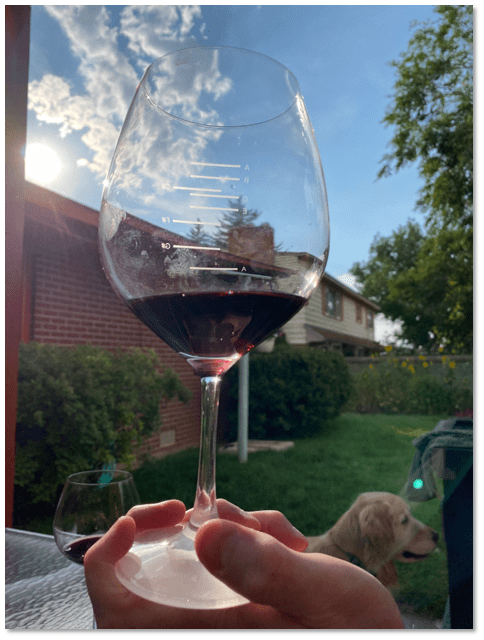
So what was the verdict? As mentioned in our previous review, I don’t want to get too bogged down in absolute numbers. Our experience was the key, with family and good friends sharing cheese and crackers and preparing for a good meal, a nice patio on a warm Wyoming summer night, and a very good dog!
Overall, our tasters ranked it 8 out of 10 (again, with 10 being the most wonderful wine you’ve ever had in your life). But the experience can’t be beat – a perfect 10 again!
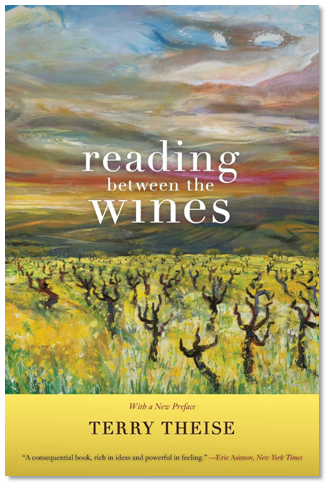
Along those lines, I have been intrigued by something Terry Theise wrote in his wonderful book Reading Between the Wines. You may (or may not) remember that I mentioned his other book, What Makes a Wine Worth Drinking: In Praise of the Sublime, in our review of Gigondas (#5 in our series). Both of his books are fascinatingly philosophical about wine and its subtleties and powers. He is who taught me about the “experience” of drinking and sharing wine being infinitely more important than numerical ratings and spending too much time parsing specific flavor and aromas. In Reading Between the Wines, he posits the option of having five groups – “fair/good/very good/excellent/superb” – as wine ratings, but he concludes that it would wind up being just a five-point rating system instead of 10 or 100. I tend to agree, but I am intrigued by those descriptors. I may propose it next time! In the case of our Côte Rôtie, I’d have to put in the “excellent” (and approaching “superb”) category. But so far, all of the wines we’ve tried would likely be in that category too. It’s all good – I mean excellent!

Where can you get it? Prices for our 2017 Denuziere Côte Rôtie range from around $70 to $90 a bottle – I found it at $70 at Total. You can of course, go big or go home if you want, as other, more … um… sophisticated vintages can go for $400 or more!
Wine book recommendation: You can’t go wrong with Terry Theise’s Reading Between the Wines if you want to continue to explore the philosophical side of wine, both making and drinking. As Eric Asimov says, it is “A consequential book, rich in ideas and powerful in feeling.”
What happens next? So far, we have reviewed seven wines mentioned in Kermit Lynch’s wonderful book, from a variety of regions. I will be fortunate enough to be able to tour France in the coming weeks, making stops in the Burgundy, Rhône, Bordeaux, and Loire valleys to see the sights and (mainly) tour local wineries and taste good wines. I hope to focus on some of the remaining wines mentioned in Lynch’s book, and I may focus on some others not mentioned in the book too. But I hope to keep up the blog while there, so stay tuned. À votre santé!
 The Cellar Door
Bacon 🥓 in a bottle huh?!?!
I must try this one,although it’s a little above my price range!
Lisa A. Goodbee, P.E.
lisa@goodbeeassoc.com
http://www.goodbeeassoc.com
LikeLike