(Posted January 18, 2023)
“In wine, there’s truth.” ― Pliny the Elder
“This is the sixteenth and seventeenth in a review of wines that were mentioned in the great book by Kermit Lynch, Adventures on the Wine Route: A Wine Lover’s Tour of France. Once again a reminder – Lynch’s book is by far one of the most enjoyable and informative books about wine you’ll read.
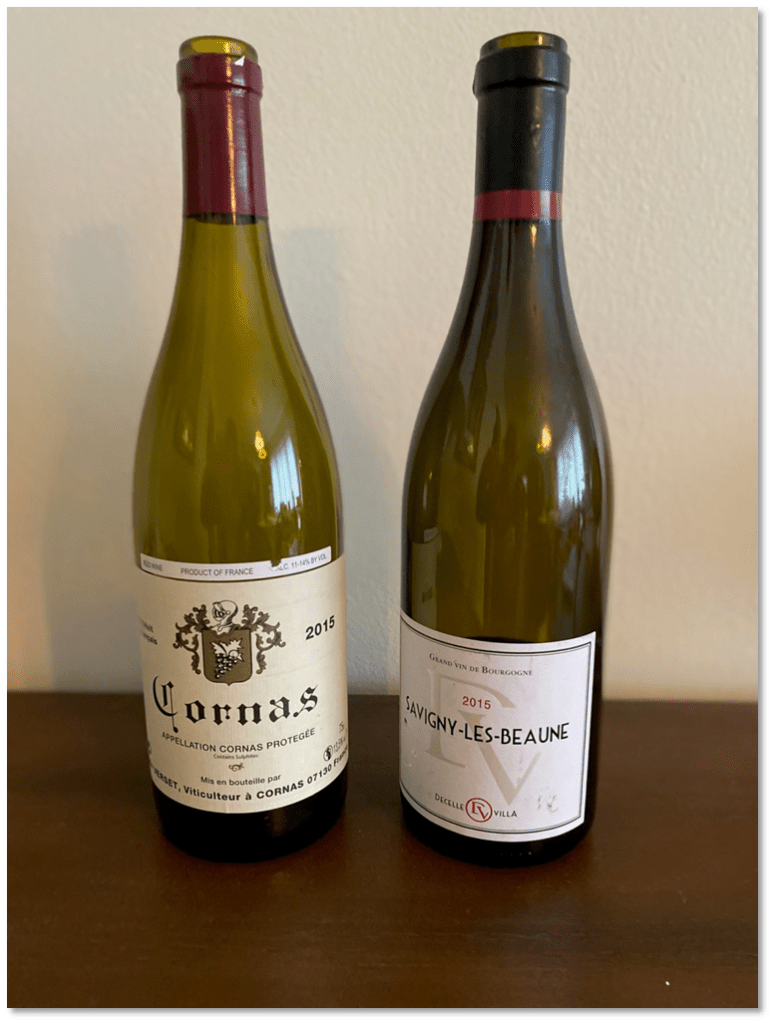
Our wines for this review are a 100% Pinot Noir from Burgundy – a 2015 Decelle-Villa Savigny-les-Beaune – and a 100% Syrah from the Rhône Valley – a 2015 Verset Cornas.
As with the previous French wines I posted about, my approach to reviewing these two was a little different – I used the excuse of a party to ask attendees to taste both and give me their impressions. We’ll get to the results in a bit, but first, a little background.
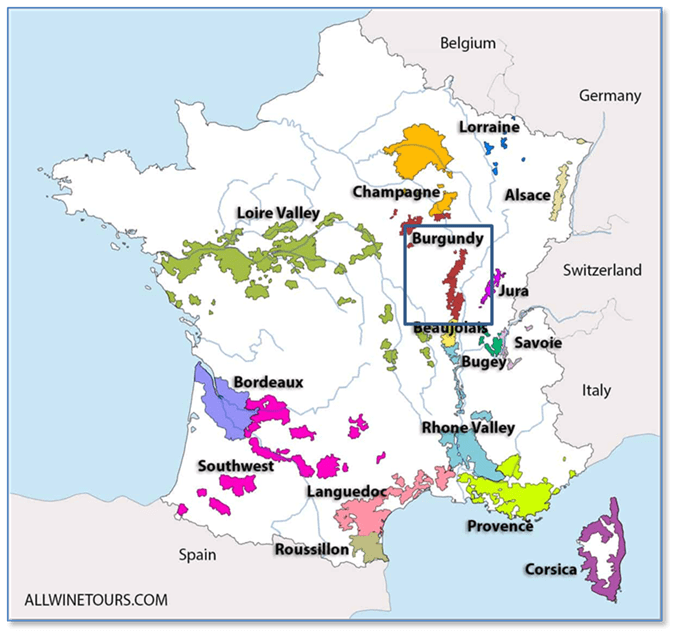
The Decelle-Villa Savigny-les-Beaune: As a refresher from wines from Burgundy we’ve reviewed earlier, Burgundy is, of course, a famous wine-growing region in east central France. Called Bourgogne in French, it is famous for well-regarded red and white wines, with whites coming almost entirely from Chardonnay grapes and reds from Pinot Noir. According to The Oxford Companion to Wine, vineyards dating to the first century have been found in the area. A tribe of Burgundians from Scandinavia settled the area in the fifth century, giving the area its name. As noted in The World Atlas of Wine, “Burgundy is not one big vineyard, but the name of a province that contains several distinct and eminent wine regions.” Savigny-les-Beaune is a small town in the northern part of the Côte de Beaune subregion of the Côte d’or Region (the heart of the Burgundy wine region).
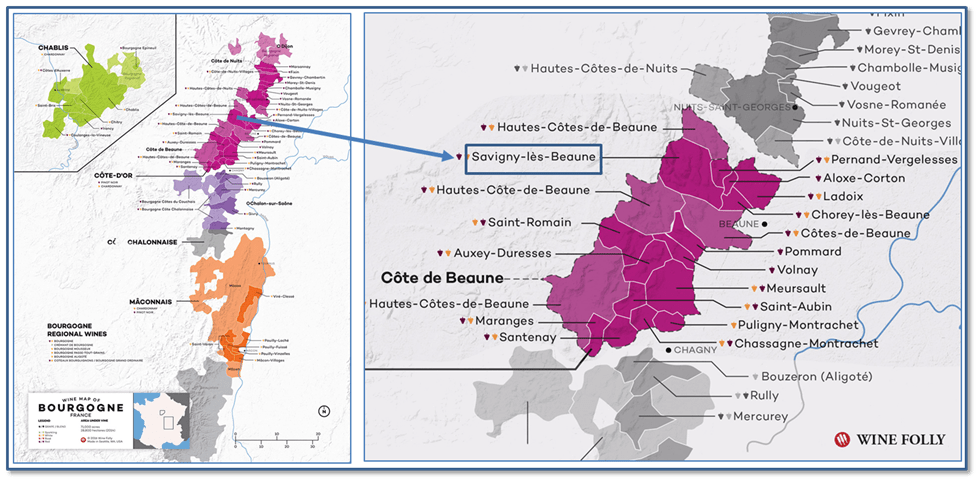
Kermit Lynch wrote of Savigny quite a bit in Adventures on the Wine Route. One in particular – produced by the Pichenot brothers – particularly caught his eye. “I like the way their wine smells, the expansiveness of it, the solid Pinot quality, some earthiness, a little reminder of the barnyard, a hint of black pepper, its candid, rustic charm.” He also provides some tips on trying red Burgundies: “Listen to it, see what is has to say, get to know it…. Do not demand thick, heavy Burgundy. More often than not, this is a sign of overchaptalization. Instead, look for personality, aroma, lucidity, finesse, wonder, and magic.”
Let’s do a quick primer on one interesting word in that quote: chaptalization. The Oxford Companion says it is a “common winemaking practice, named after its French promulgator Jean-Antoine Chaptal, whereby the final alcoholic strength of a wine is increased by the addition of sugar to the grape juice… before and/or during fermentation….” The Oxford Companion goes on to say:
Producers of Pinot Noir, most notably in Burgundy but also in Oregon and elsewhere, often add sugar during alcoholic fermentation, particularly towards the end, even if some might not readily confess to it. The aim is not primarily to increase the final alcohol level but to extend the fermentation and thereby improve the flavor and texture of the wine.
More from The Oxford Companion on Savigny: “An engraving dating from 1703 at the Chateau de Savigny describes the wines as nourishing, theological, and disease defying…. The reds [of Savigny] are agreeable, rivaling those of Beaune itself…” And The World Atlas of Wine tells us that Savigny “can be a marvel of finesse.”
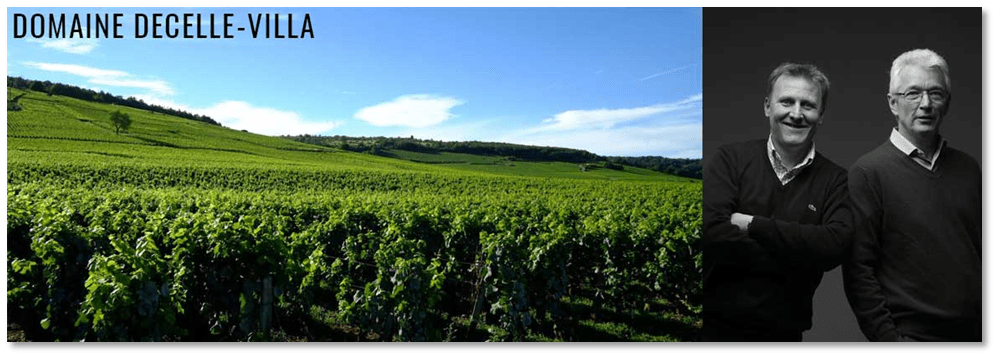
As for the winemakers themselves, heightschateau.com tells us that Decelle-Villa is a partnership started in 2008 “between two of France’s best-known winemakers [Oliver Decelle and Pierre-Jean Villa], dedicated to the production of high quality Burgundy wines…. This single-vineyard red is a stunning wine, spicy and structured, fresh and round on the palate, with silky-soft tannins, bright acidity, and a long finish.”
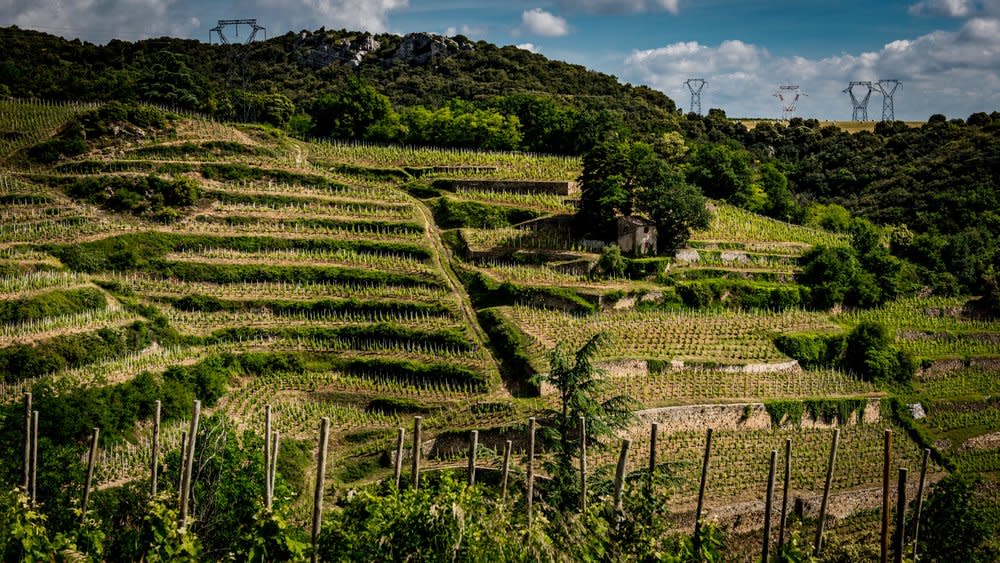
Our second wine was the Verset Cornas, a 100% Syrah from the Cornas area of the northern Rhône River valley. The Oxford Companion says that the appellation “was renowned in the 18th century, but many of the terraced vineyards on its steep south-facing granite slopes fell into decline in the early 20th century. The appellation experienced a revival of interest in the late 1980s with the arrival of ambitious newcomers prepared to re-establish the terraces needed for high quality vineyards.”
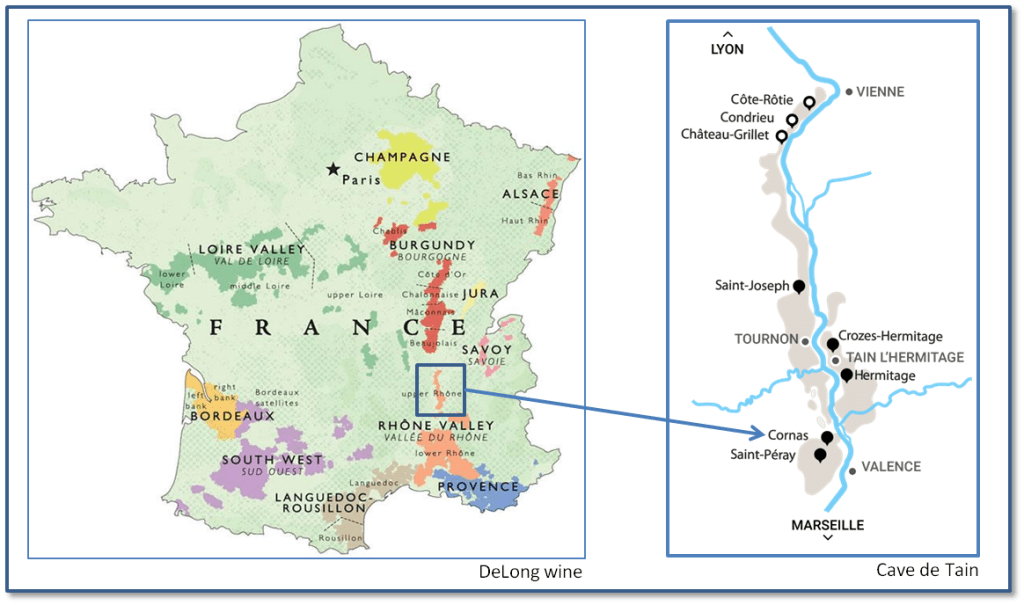
Kermit Lynch writes about Cornas’ small stature compared with other vineyards:
In terms of wine itself my heart belongs to the great reds of the northern Rhône. The best combine a reminder of the sunny Mediterranean with the more self-conscious, intellectual appeal of the great Burgundies farther north, which is not a bad combination. And these prized wines of the northern Rhône are France’s rarest: Hermitage has 300 acres planted in vines compared to 7,900 at Châteauneuf-du-Pape. Gigondas has 2,600; Cornas, only 130. To bring it into perspective, Vieux Télégraphe, a single domaine at Châteauneuf-du-Pape, has the same surface in vines as all of Cornas….
He also writes vividly and admiringly about the grape used to produce the Cornas and other nearby reds:
In contrast to the numerous grape varieties permitted down south, the northern Rhône reds are the result of a single variety, the Syrah. One would think that a blend of grapes could create a more complex range of aromas and flavors than a lone variety, yet the Syrah juice eked out from one of these steep hillsides can produce wines of dazzling complexity, wines whose exotic aromas seem to shimmer and change like the flashes of color gleaming from a jewel.
Now that’s great wine writing!
Our Cornas came from the domaine Alain Verset. The website Fine + Rare tells us that Noel Verset, Alain’s uncle, was “one of the world’s great wine legends. His staggering 75-year winemaking career was instrumental in putting Cornas on the fine wine map.”
Empirewine.com tells us: “No one is more revered in the northern Rhône than Noel Verset. But it is not widely known that Noel had a brother, Louis…. While Noel finally retired in 2007 after 63 vintages, Louis stopped making wine in 1994…. Louis had a son, Alain, who took over the domaine upon his father’s retirement…. He continues to make fine old-school Northern Rhône wines, still bearing the mythic Verset name.”
What was our experience? Crowdsourcing – again!
As mentioned earlier, for these two wines, I again tried something a little bit different from most previous tastings – a party of about 20 people, with a rating sheet asking for samplers’ opinions on aroma, taste, and texture, and overall impressions. Here’s what we found out:
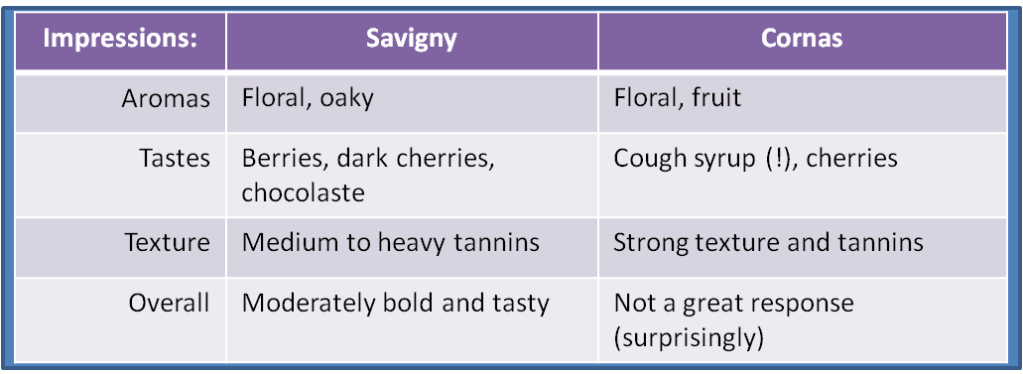
I also asked everyone to vote on which one they liked best. Of the six people who voted, all preferred the Savigny.
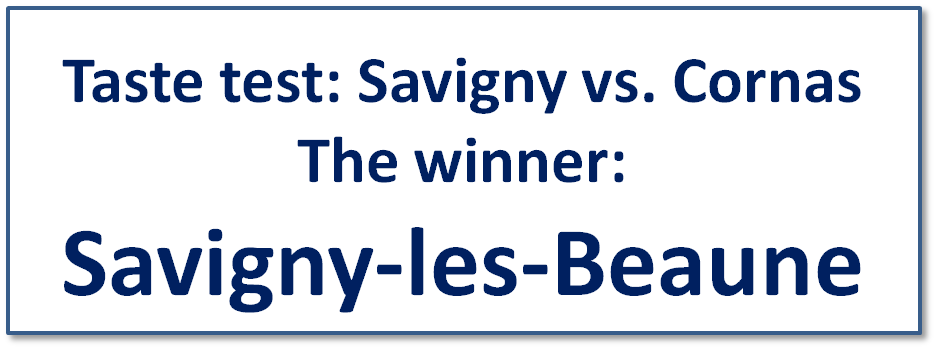
My vote: I initially liked the Savigny the best too. I thought it was smooth and dark, full of dark berries and chocolate. I wasn’t initially impressed by the Cornas, but I will say that a couple of days later, I tried it again and thought it was quite delicious. I think it needed to breathe more and age slightly in the bottle. In my experience, Syrah can be feisty and unpredictable, especially depending on where it’s from, but after a day or so this one was better than it was after it was just opened (and yes we did let it breathe!).
You can find the Savigny for around $50, and the Cornas for about $60.
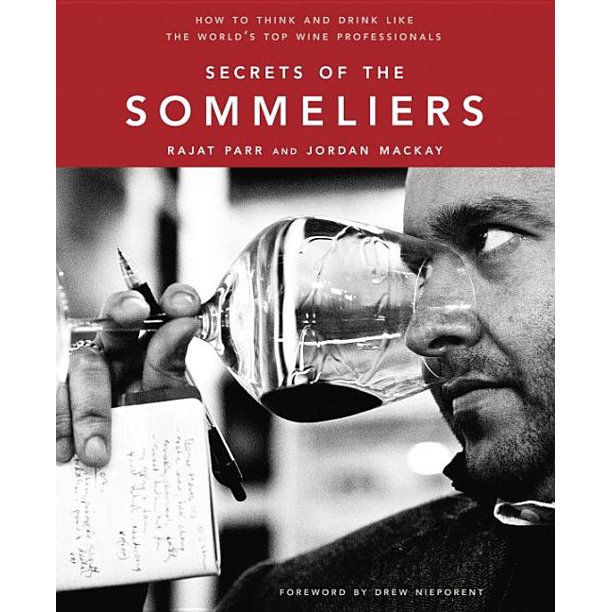
Book recommendation: One of my favorite wine books is Secrets of the Sommeliers: How to Think and Drink Like the World’s Top Wine Professionals by Rajat Parr and Jordan Mackay. It is full of handy tips, including demystifying the world of somms, tasting/buying/storing wine, pairing wine with food, serving and ordering wine, and how to think like a sommelier.
Wine Playlist: As mentioned in earlier posts, I like to create fun and funky playlists based on some of my interests, so I’ve created a wine playlist – songs with titles or lyrics that include wine. You can find it on Spotify at https://open.spotify.com/playlist/5rAwgh9Thiary4zUplUsaN
Here’s this post’s entry: “Napa Crossroads Overture,” from the album Napa Crossroads put together by David Pack (otherwise known as the lead singer for the group Ambrosia), and featuring the wonderful piano of David Benoit.
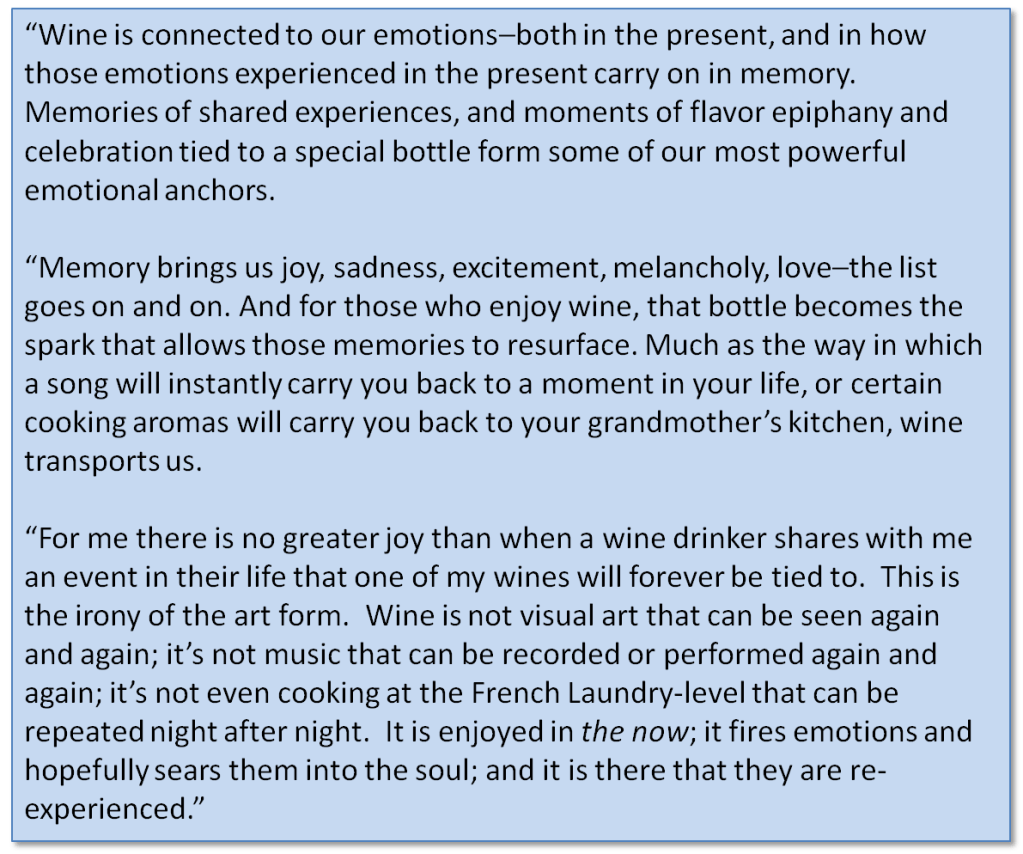
One final note: I’d like to sign off this first post of the new year with a “guest post” that I saw in the weekly blog of Karen MacNeil, the author of The Wine Bible (by the way, if you don’t subscribe to that newsletter, you should – it’s called “Winespeed” and you can subscribe to it at her website at www.karenmacneil.com). She included “A Winemaker’s Thoughts” by Chris Carpenter, and I thought it was eloquent and gave life to my thoughts about wine and how it can be such a positive in our lives. Happy New Year everyone!
 The Cellar Door