(Posted September 17, 2025)
“When it comes to wine, I tell people to throw away the vintage charts and invest in a corkscrew. The best way to learn about wine is the drinking.” – Alexis Lichine
Aha – you just thought I was done with reviewing wines found in Kermit Lynch’s great book Adventures on the Wine Route. A little more than two years ago, I reviewed what I thought was the last of the wines mentioned in his book that I could find (though since then, I’ve reviewed a number of “celebrity wines” to keep the blog going). But I was wrong. I stumbled on one more – a Chablis – that merits inclusion in this august blog. Yes, to my knowledge, this is the last of the wines mentioned in the book to be reviewed. But never say never. I have plans for something else in the next few months. A book perhaps? Still pondering my options.
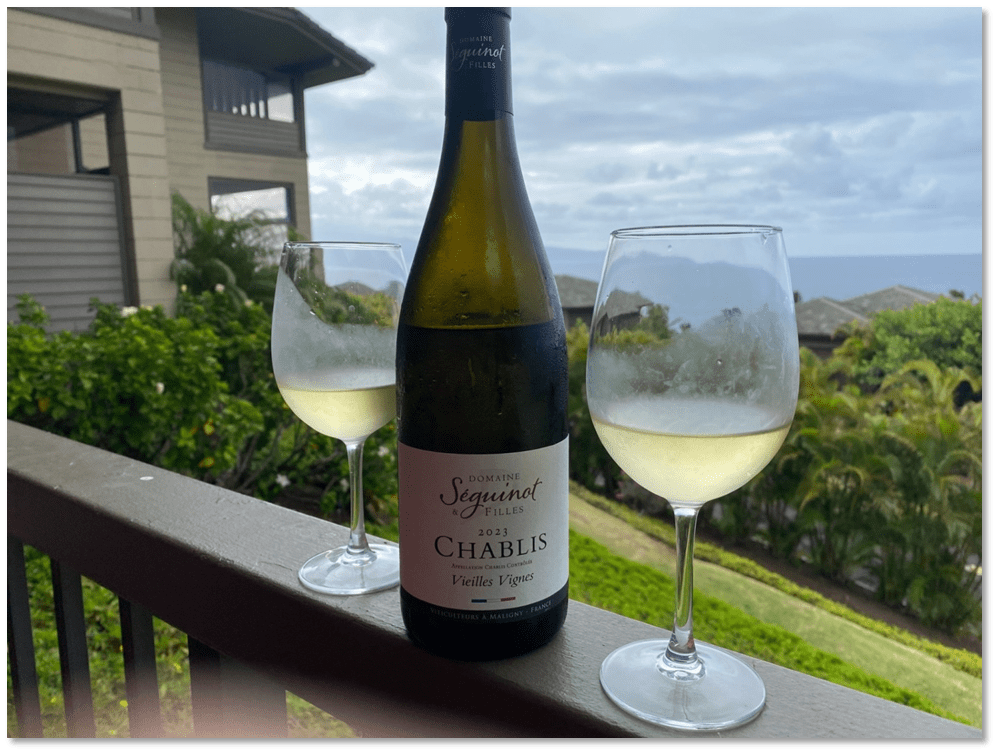
Regardless, we can review what I believe to be the final wine on my Kermit Lynch list now that I am permanently ensconsed in the place where I got the inspiration for this blog in the first place – Maui. The nineteenth and final (at least for now) wine on the list is a 2023 Chablis (Chardonnay) from the Burgundy region of France from the Domaine Séguinot & Filles.
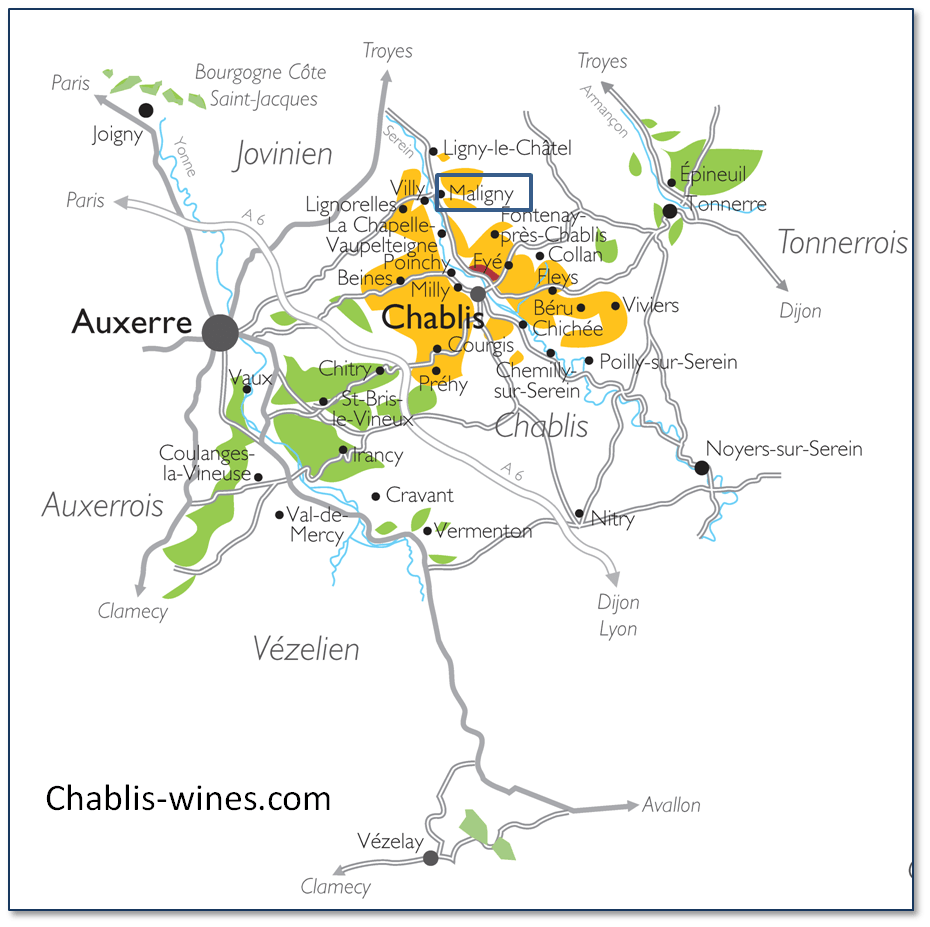
First of all, where is Chablis? It is part of the Burgundy region in east-central France, but it is what you might call an appendage.
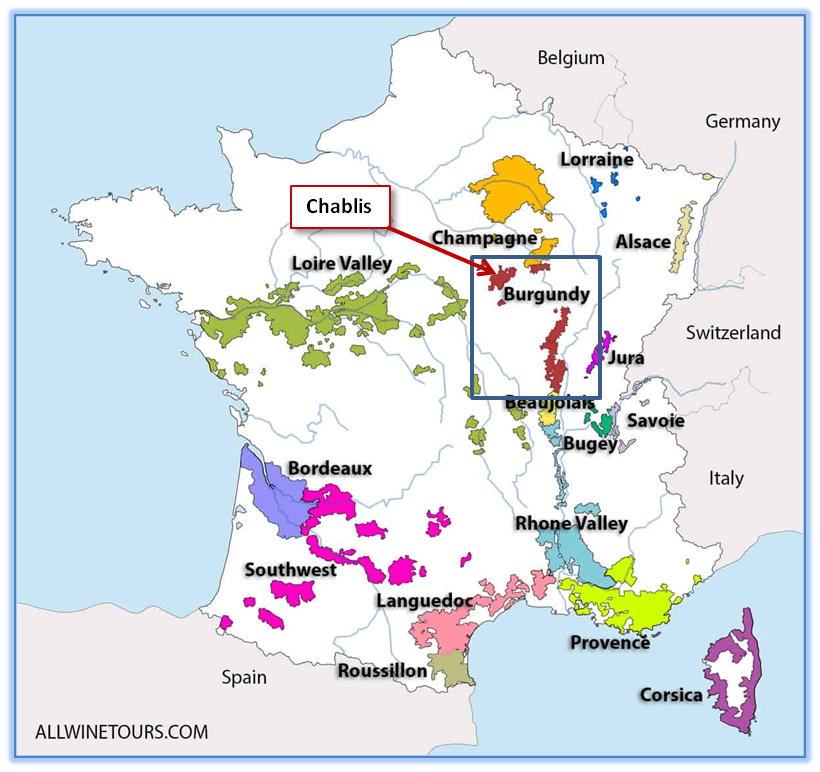
To repeat some of the geographical information I shared in previous reviews, Burgundy is, of course, a famous wine-growing region in east central France. Called Bourgogne in French, it is famous for well-regarded red and white wines, with whites coming almost entirely from chardonnay grapes. According to The Oxford Companion to Wine, vineyards dating to the first century have been found in the area. A tribe of Burgundians from Scandinavia settled the area in the fifth century, giving the area its name. As noted in The World Atlas of Wine, “Burgundy is not one big vineyard, but the name of a province that contains several distinct and eminent wine regions.”
As for our specific area’s history, Chablis has quite a lot of it, according to Chablis-wines.com:
- “The name Chablis is thought to come from two Celtic words: ‘cab’ meaning house and ‘laya’ meaning ‘near the wood.’
- The settlements in the area started in Neolithic times, followed by the Gauls and Romans.
- In the 9th century, Benedictine monks from the Loire fleeing the Vikings settled in the area, establishing the first major vineyards.
- Cistercian monks settled in the area in the 12th and 13th centuries, establishing more vineyards.
- In the 16th century, Chablis was attacked and largely destroyed by the Huguenots (darn those Huguenots!), and it took two centuries or more for the region to return to prosperity.
What did Kermit Lynch write about Chablis?
Kermit Lynch had mixed feelings about the Chablis region; at least he did when he wrote his book in 1988. The chapter on Chablis is the shortest one in the book. Let’s just say it’s probably not Chablis Chamber of Commerce material:
[T]he white Burgundy that raises the hair on my back, that arouses passions ranging from teeth-gnashing outrage to utmost euphoria…. It is Chablis, northernmost Chablis, the yellow to golden-green wine from the gray, forgettable village of the same name…. I worked to turn up a wine worthy of the fabled name Chablis, worked my palate to the quick in that bleak, drizzly, stone cold village. Perhaps because its wine was too sour to the German taste, their bombers practically destroyed Chablis in June 1940, and I think its citizens still have not forgiven the rest of the world for that misfortune….. Aside from bombing runs and the local little cheese biscuits called gougėres, wine is the only reason to go to Chablis. Otherwise, watch out for cold sheets, questionable quenelles, and frostbite. [For the uninitiated, a quenelle is, according to Wikipedia, “a mixture of creamed fish or meat, sometimes combined with breadcrumbs, with a light egg binding.”]
Kermit, why all this unhappiness? Must be the weather….
Bitter? Yes, I am bitter. Loving Chablis is like falling in love with a frigid floozy. You begin to wonder if the rewards are worth the heartbreak and deception. And the vignerons there are bitter. They are bitter because of the frost and hailstorms that terrorize their grapevines. Imagine watching the fruits of your year’s labor destroyed in an evening. In his late-sixties book about Burgundy, Pierre Brejoux wrote that the harvest from the steepest Chablis slopes is destroyed two out of three years….
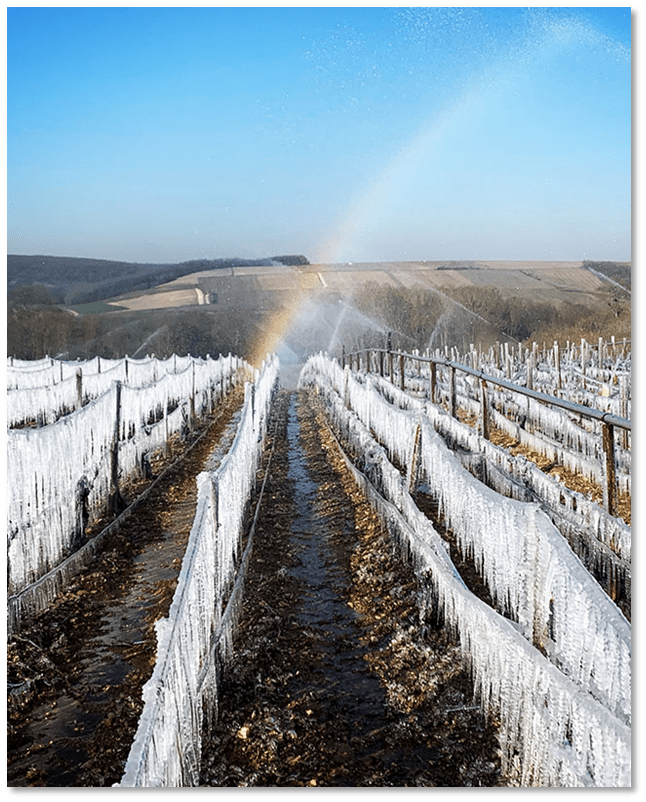
Along those lines, the Chablis region is often described as having a “semi-continental climate.” The Oxford Companion to Wine says that means a climate “with no maritime influence, so that its winters are long and hard and the summers often, but not always, fairly hot. There is all the climate uncertainty, and therefore vintage variation, both in quality and quantity, of a vineyard far from the equator….” with the most uncertain aspect being the potential for spring frosts, “which can cause enormous damage to the young vine shoots.” The Domaine Seguinot & Filles website has a photo showing how its vineyards are sometimes sprayed with water to protect the young shoots from frost.
So let’s explore our wine from Domaine Séguinot & Filles. First of all, the lone Chablis mentioned in Kermit Lynch’s book was from Domaine François Raveneau, which is still in business today. However, the Raveneau was … um … prohibitively expensive (anywhere from $200 to $500 depending on the exact vintage). In addition, the wine selection in my new home (on Maui) is limited to say the least – more on that later. So I thought the Séguinot would make an acceptable substitute.
The British wine distributor Boutinot (apparently the main distributor of Séguinot & Filles wines) provides some background on the winery:
In Maligny – as far north in Chablis as you can get – on the right bank of the river Serein, Domaine Daniel Séguinot is a small, 27 hectare [67 acres] estate founded in 1971. It is now run by Daniel’s charming and very switched-on daughters, Emilie and Laurence. Since they took over the running of the business from their father they have been instrumental in the move to domaine-bottled wines, produced without oak in a very pure, linear style.
I’m not quite sure what “switched-on daughters” means in this context (they look pretty normal to me in the photo below); maybe it’s a French thing that got lost in translation? But anyway, let’s move on.

What is different about Chablis wine?
Chablis-wines.com tells us, “Chablis wines are dry white wines which are characterized by their purity, crispness, sophistication and minerality. The Chardonnay varietal gives results in Chablis unlike anywhere else. It draws its personality and character from a subsoil that is 150 million years old, and ripens in ideal conditions, in a semi-continental climate [see earlier description], which allow[s] it to attain a good balance between sugar levels and acidity.” Wine Searcher says that “Chablis is arguably the home of unadorned, cool-climate Chardonnay, producing white wines of great freshness, longevity and beguiling minerality.”
The Oxford Companion to Wine tells us, “Chablis is the uniquely steely, dry, age-worthy white wine of the most northern vineyards of Burgundy in north east France…. The vineyards of Chablis are much closer to Champagne and its southernmost vineyards … than to the rest of Burgundy, and until early in this century it was not unusual for wine from Chablis to find its way into the champagne makers’ cellars…”
The Oxford Companion goes on to say: “Chablis remains one of the great white wines of the world. It is sometimes overshadowed by the greater opulence of a fine Meursault [which I wrote about earlier, #13 in the series] … but it has an individuality of its own that sets it apart from the great white burgundies of the Côte d’Or.” Chablis has a “unique streak of steely acidity, a firm flintiness, and a mineral quality that is not found elsewhere in Burgundy.”
What were we to expect from this Chablis?
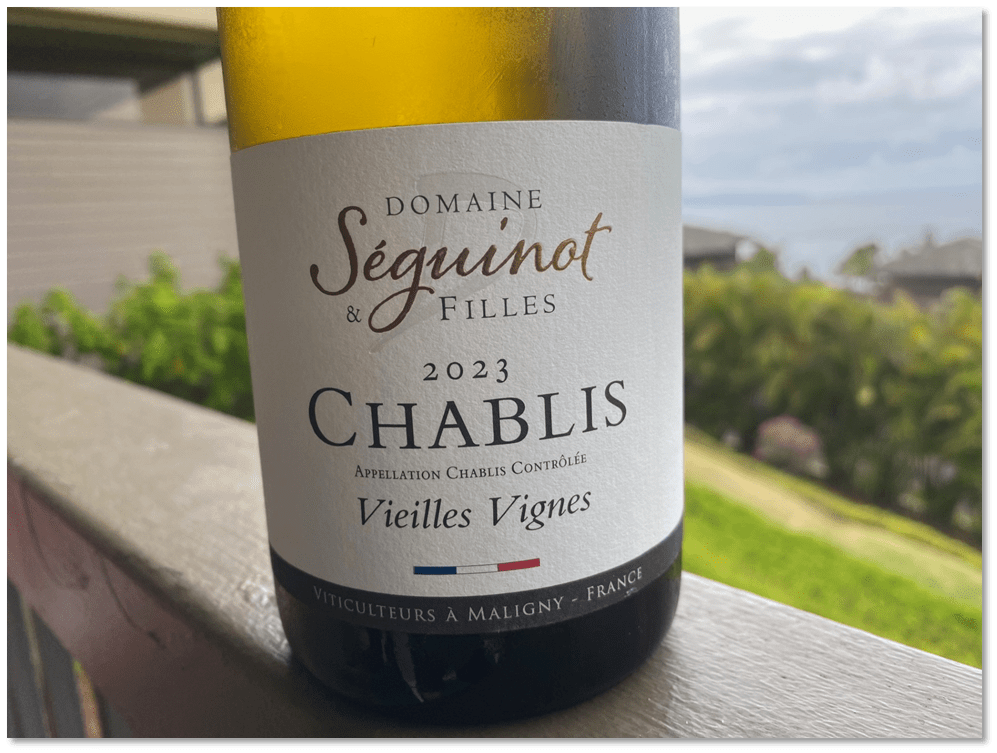
Our specific wine was a 2023 Vielles Vignes (which means “old vines”). The Domaine Séguinot & Filles website tells us that this is “a powerful, mineral Chablis…. A special cuvée made from a single harvest of a fifty-year-old vine, the first vine planted by Daniel. The Domaine produces this wine in 1.50 ha [approximately 4 acres]. The light clay-limestone soils and this old vine give this cuvée fruity, rich aromas.” Total says it is “An elegant and complex display of lemon, melon and pear flavors, with notes of almond cookies and sea shells. Medium-bodied with a balanced finish.” Now that’s a combination you don’t see every day: almond cookies and sea shells!
What were our observations?
First, an explanation. We (Lisa and I) now live on Maui. We moved here permanently from Denver a year ago. That’s the good news. The bad news is that our wine selections here are … somewhat limited. Wine is available in every grocery store, but given the long-distance shipping issues, every store has just about the same (limited) selections. And trying to have wine shipped from wineries or distributors on the mainland is often not available at all or prohibitively expensive. Sooooo… we found this Chablis at a Total in Denver and brought it back in a suitcase after our most recent trip to the mainland, not knowing anything of its provenance, and decided to give it a try.
Our verdict: it was excellent. Its color was a pleasant greenish-straw color, and it was dry and citrusy with notes of pear and green apple (yes I know those aren’t citrus but we did the best we could!). Great minerality and very refreshing, especially if it is super chilled. After a few minutes, it opened up very nicely, a little tingly on the tongue but a wonderful wine to drink cold on our Maui lanai. Its alcohol content was 13%, and you can find it for about $30.
Where do we go from here?
Not sure. As mentioned earlier, I’m pondering incorporating my wine blog posts into book form of some kind, sort of a joint tour of France with Kermit Lynch (or his book at any rate). Stand by – more to come I hope!
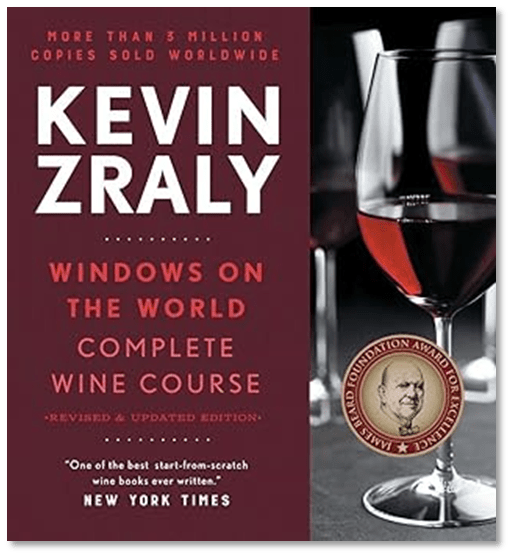
Book recommendation: One of the best resources out there is Kevin Zraly’s Windows on the World Complete Wine Course. It’s a hefty reference book that provides great information on all the major wine regions of the world and their wines (with wonderful maps and lists of the best wines from each region), along with recommendations on food and wine pairings, best values, wine quizzes, and other fun stuff.
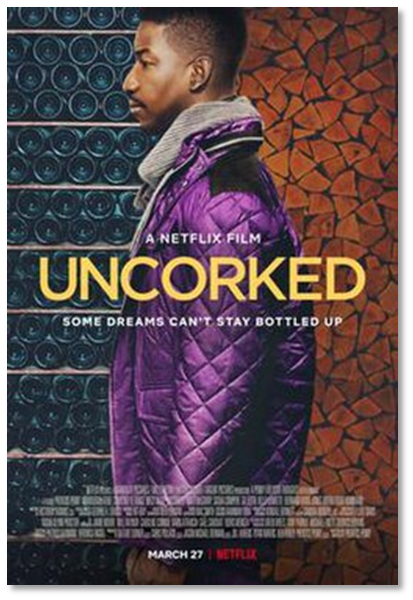
Wine-related movie recommendation: One of my favorite relatively unknown wine-related movies is Uncorked, a Netflix film from 2020, about a young man in Memphis with unlikely wine dreams. Here is its description from Netflix: “Elijah must balance his dream of becoming a master sommelier with his father’s expectations that he carry on the family’s Memphis BBQ joint.” It stars Mamoudou Athie, Courtney B. Vance, and Niecy Nash. Highly recommended!
Wine Playlist: As mentioned in earlier posts, I like to create fun and funky playlists based on some of my interests, so I’ve created a wine playlist – songs with titles or lyrics that include wine. You can find it on Spotify at https://open.spotify.com/playlist/5rAwgh9Thiary4zUplUsaN
Here’s this post’s entry: “Yesterday’s Wine,” by Willie Nelson, a lament on growing older.
“Yesterday’s wine/We’re yesterday’s wine/Aging with time/Like yesterday’s wine…”
Santé! Until next time and our next great adventure!
 The Cellar Door