(Posted March 20, 2022)
“I love everything that is old; old friends, old times, old manners, old books, old wines.”
― Oliver Goldsmith, The Vicar of Wakefield
This is the ninth and tenth in a review of wines that were mentioned in the great book by Kermit Lynch, Adventures on the Wine Route: A Wine Lover’s Tour of France. Once again a reminder – Lynch’s book is by far one of the most enjoyable and informative books about wine you’ll read.

Our wines for this review are wonderful whites from the beautiful Côte d’Or wine region of Burgundy. The ninth wine in our adventure is a terrific Puligny-Montrachet from Domaine Jean Monnier & Fils. Number ten is a smooth Pernand-Vergelesses from Louis Latour.
Kermit Lynch writes:
For the great growths of Burgundy one goes to the gentle slopes of the Côte d’Or, a long, thin strip of vineyard that cannot supply the world with enough of its inimitable, incomparable nectar…. I always take a deep breath when I enter Burgundy. It is the most difficult wine to buy and its winemakers the most difficult to deal with. They are never happy. There is always too much rain or not enough…. Making Burgundy, buying Burgundy, what agony: the weather, the petit quantities, the prices, the vintages, the journalists assigning numbers to them as if they were grading term papers, the mistaken notion that big is better, the infinite occasions for this most fragile of wines to be spoiled somehow before it is uncorked… Burgundy, source of the highest highs and the most expensive depressions.
Kermit certainly had his issues dealing with the temperamental winemakers in Burgundy, and my experience visiting there in the fall of 2021 echoes that. The most overwhelming sense I got of Burgundy winemakers was pride – pride in their products, their opposition to blends, their almost incomprehensible number of climats or individual vineyards. Some wine lovers we talked to in Burgundy scoffed at other French wine regions – “Bordeaux, what do they know?”
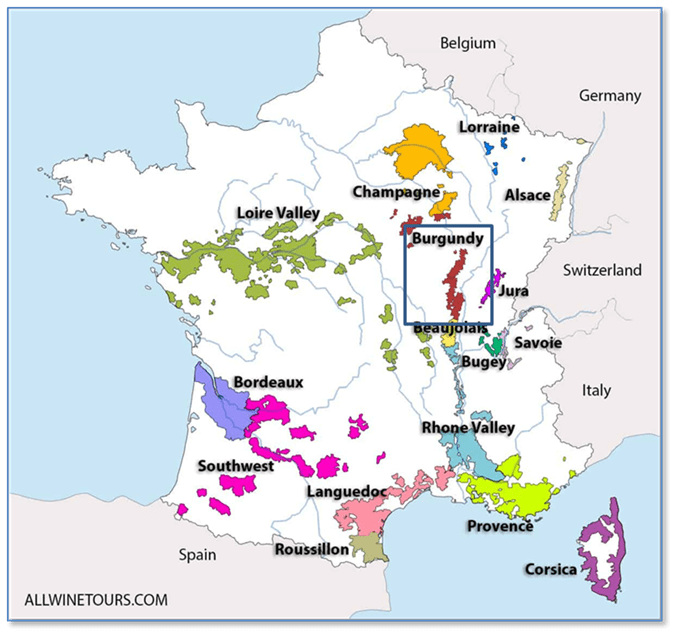
To repeat some of the geographical information I shared in review #4 (Chassagne-Montrachet), Burgundy is, of course, a famous wine-growing region in east central France. Called Bourgogne in French, it is famous for well-regarded red and white wines, with whites coming almost entirely from chardonnay grapes. According to The Oxford Companion to Wine, vineyards dating to the first century have been found in the area. A tribe of Burgundians from Scandinavia settled the area in the fifth century, giving the area its name. As noted in The World Atlas of Wine, “Burgundy is not one big vineyard, but the name of a province that contains several distinct and eminent wine regions.”
Our wines come from the Côte d’Or region of Burgundy (the word “côte” means hillside or slope, so the name of the region literally means “golden slopes” or “golden hillsides”). The Oxford Companion to Wine tells us that the Côte d’Or is “the heart of the Burgundy wine region,” and that Chardonnay is grown on approximately 49% of Burgundy vineyards (the other major wine grown there is Pinot Noir).
I mentioned climats above; The Oxford Companion tell us that the “vineyards of Burgundy, especially those of the Côte d’Or, are the most minutely parcellated in the world.”
This is mainly because the land has been continuously managed and owned by individual smallholders…. The combination of the Napoleonic code, with its insistence for every family member, and the fact that the land has proved so valuable, has meant that small family holdings have been divided and subdivided over generations. One vineyard, or climat, as it is known in this, the cradle of terroir, may therefore be owned by scores of different individual owners, each of them cultivating sometimes just a row or two of vines.
Number nine, number nine….
Kermit Lynch tells us that Puligny is one of “today’s great white Burgundy villages. Here are the Chardonnays that launched a thousand Chardonnays, which all the wine-producing countries of the world desire to emulate.”

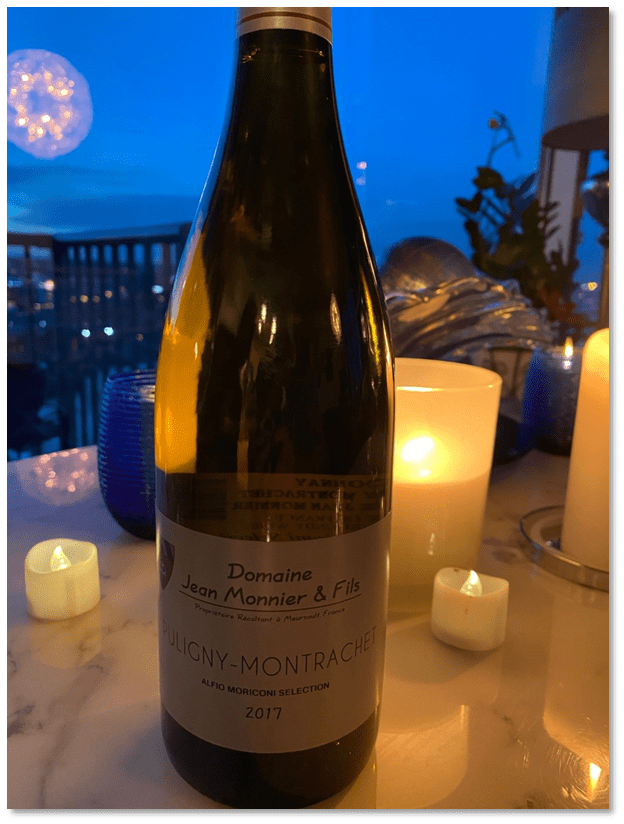
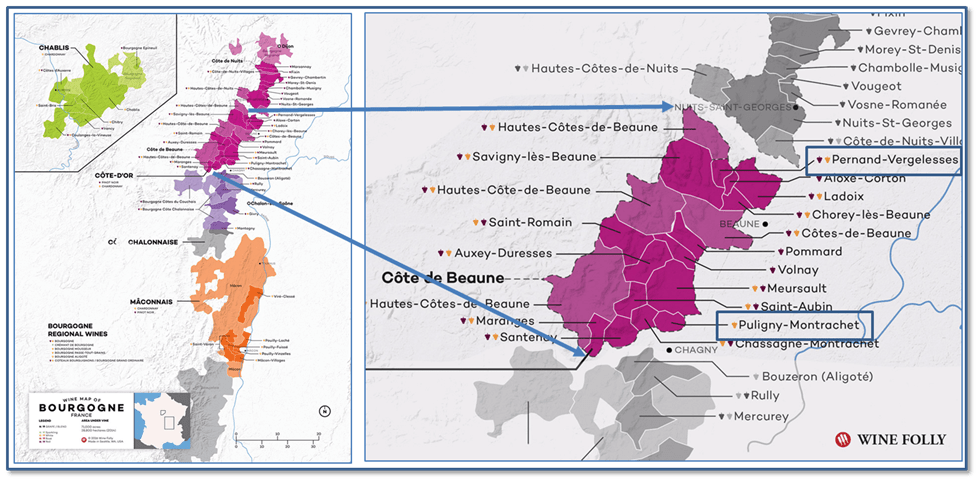
Puligny-Montrachet is a village in the southern Côte de Beaune subdistrict of the Côte d’Or region. Wine Searcher tells us that “The village was originally called just Puligny until 1879, when the Montrachet section was added in homage to its iconic Grand Cru vineyard, Le Montrachet. The origin of these names is the scrubby Mont-Rachet hillside above the village: mont meaning “hill” and rache translating rather less glamorously as either ‘scab’ or ‘rash.’”
The wines from this village are known worldwide as excellent Chardonnays. Wine and Bean says: “Its blend of limestone soil, climate, and Chardonnay grapes enable the production of white wines with unparalleled quality. The structure and character of the style are marked by a full body with a mineral core and rich aromas of elegant fruit. Their reputation is reflected in their price.
Wine Searcher tells us that “it is the high-quality white wines – regarded by many as the finest possible expression of Chardonnay – that are responsible for Puligny’s fame and stellar reputation. The undeniable success of Chardonnay here is the result of several factors – most of them encompassed by the concept of terroir. The local combination of topography, soil structure and climate gives producers high-quality grapes with which to make their wines.”
And Vins de Bourgogne says that “Puligny-Montrachet, along with Chassagne, is the most perfect expression of the Chardonnay grape.” High praise indeed!
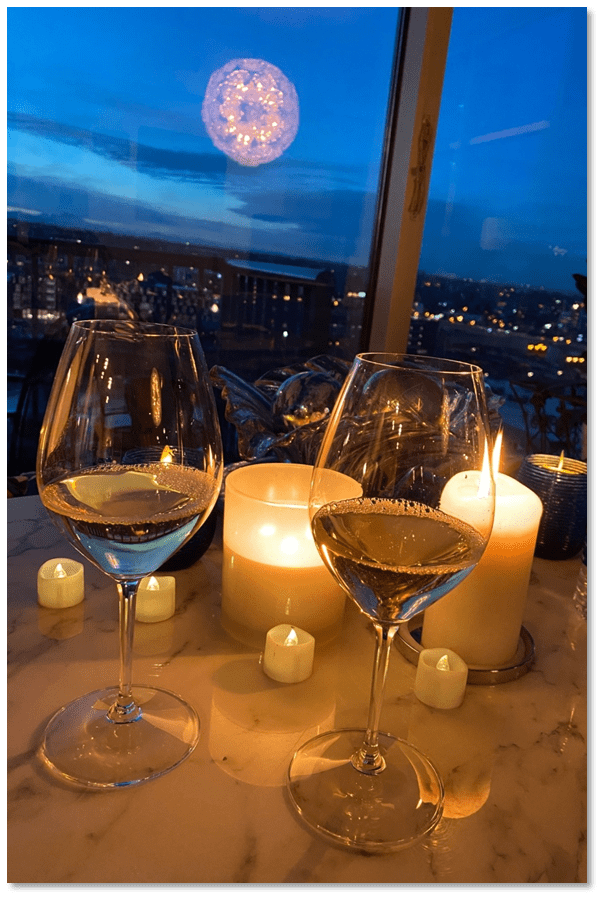
So what were we to expect? Vins de Bourgogne says that Puligny-Montrachet “is a bright gold colour with greenish highlights, becoming more intense with age. The bouquet brings together hawthorn blossoms, ripe grapes, marzipan, hazelnut, amber, lemon-grass and green apple. Milky (butter, hot croissant) and mineral aromas (flint) are commonplace, as is honey. Body and bouquet blend into a subtle harmony. This wine combines grace with a well-defined character and a remarkable concentration.” Winetourism.com says, “This appellation’s white wine has a bright gold color with greenish highlights, becoming more intense with age. The bouquet brings together hawthorn blossoms, ripe grapes, marzipan, hazelnut, amber, lemon-grass, and green apple.”
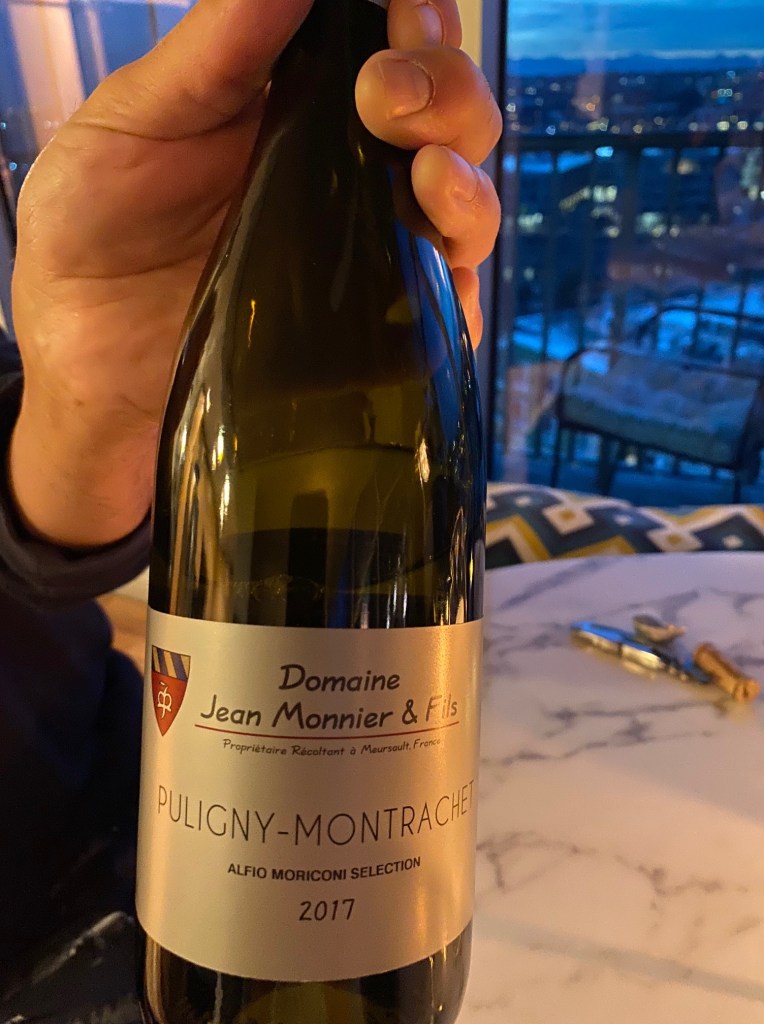
Our specific wine was a 2017 from Domaine Jean Monnier et Fils. Wine Enthusiast says, “This wine balances intense fruit with a steely core of minerality. It is packed with apple, crisp pear and kiwi fruits, contrasted with this tight texture and hints of wood aging.” BBC’s Good Food and Wine Club says its aroma has “Classic notes of citrus, hazelnut and integrated, toasty oak,” and that its taste is “Smooth, creamy and exceptionally well balanced with a crisp finish.”
What was our experience? I can honestly say that this was one of the best Chardonnays I have ever tasted, and my guest taster (Lisa) agrees. We detected green apple, honey, and hazelnut, with a slightly nutty aftertaste. One tasting note we read (as noted earlier) was hawthorn. Now I’m not too familiar with hawthorn, but I did hear it mentioned quite a bit when we were tasting wines in France in the fall of 2021 (in French it’s aubépine). Hawthorn is a tree with small fruit and fragrant blossoms that is mentioned in Kermit Lynch’s book primarily in the Rhône valley as contributing to an aroma often found in that area’s red wines. We were unfamiliar with its aroma until we sampled it in our “smelly kit” – the Le Nez du Vin. The guidebook included in the kit tells us that “the smell of hawthorn is reminiscent of bitter almond or star anise.” The sample included in the kit indeed smelled of almonds; once we were familiar with its scent, we definitely detected it in the wine, in both its aroma and its taste (yes, I know… power of suggestion and all. But it definitely did help us define what we were smelling and tasting).
Its alcohol content was medium (13%), its acidity was low to medium, its body was light to medium, and it was absolutely gorgeous in the glass. We both love French white wines (most recently we have been on a Sancerre kick), but this was about the best we have ever had. I repeat, THIS WAS ONE OF THE BEST FRENCH WHITE WINES WE HAVE EVER HAD.
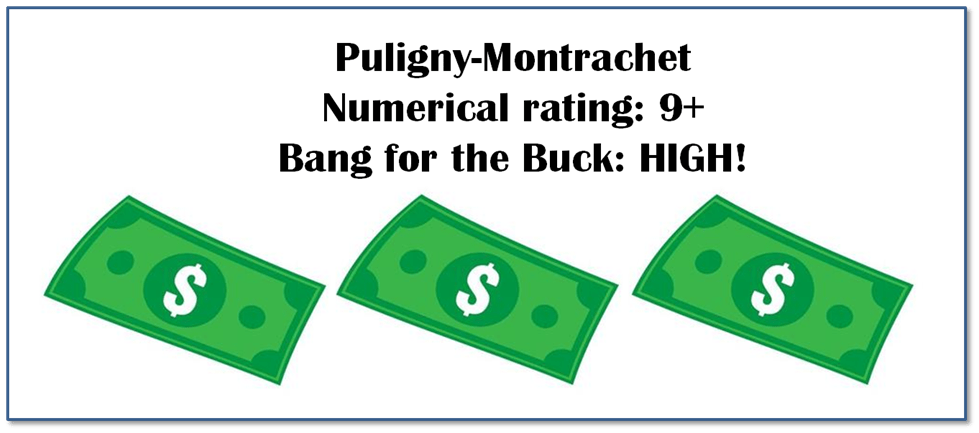
So what was the verdict? On a scale of 1 to 10, this would have to be a 9 or possibly even higher. But we have been pondering a better way to evaluate wines. From this point on, we are including the “bang for the buck” scale. In other words, is a wine’s quality worth its price? Would we experience something just as good in a less expensive wine? In our case, the Monnier was priced at around $75, though you can find it slightly cheaper if you shop around. But on the “bang for the buck” scale, this was definitely HIGH!!
Next up….
The next white Burgundy we tried was the Pernand-Vergelesses, from village of the same name in the northern Côte de Beaune subdistrict of the Côte d’Or region. The Oxford Companion to Wine tells us that white wines from this village “have a hard but attractive flinty character which develops well during bottle ageing.” Wine Searcher tells us:
The appellation’s white wines are more highly regarded than the reds. While adjacent to the red wine grand cru stronghold of Corton, Pernand is located on the western side of the Corton hill…. On this side of the hill, the terroir is quite obviously better suited to Chardonnay – producing flinty, austere wines which develop famously well with ageing. In fact, the Premier Cru vineyards in this immediate area hold the classification exclusively for their white wines. Pernand’s location, wedged between the Corton hill and the eastern slopes of the Côte d’Or, means that its vineyard sites are doubly sheltered from the prevailing winds. While this protection might be an advantage in certain ways, it also corresponds to a reduction in available sunlight – a vital resource for ripening grapes in Burgundy’s cool climate. As a result, Pernand-Vergelesses wines … have earned a reputation for slightly unripe, “green” flavors.
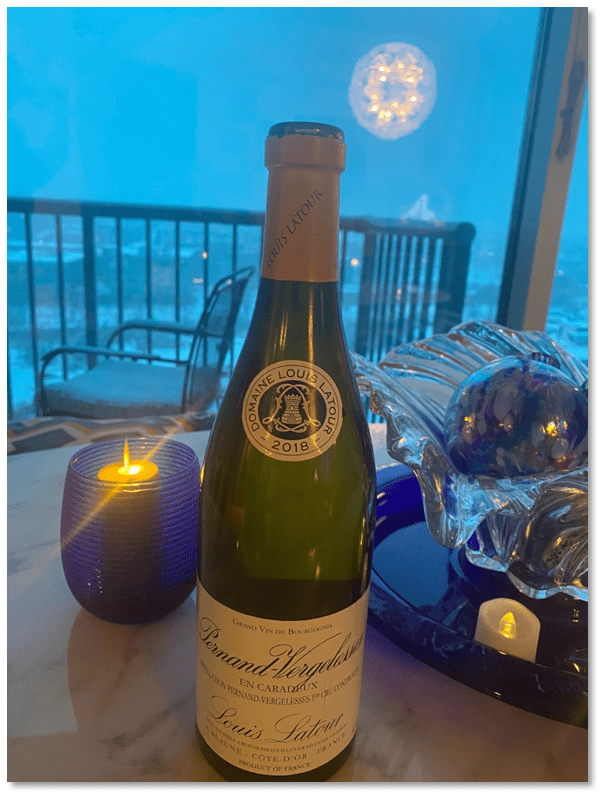
Bourgogne Info says, “This is the only commune along the Côte d’Or to offer both red and white wine on all four levels – grand cru, premier cru, village and regional…. Legend has it that the emperor Charlemagne had the vineyards replanted with grapes for white wine since the red wine originally produced there tended to stain his long white beard.”
So what were we to expect? Taste Atlas says that Pernand-Vergelesses wines “usually display aromas of white flowers and white fruits while aged version may evolve into expressions of honey and spices.” Louis Latour, the producer of the specific wine we tried, says “Pernand-Vergelesses 1er Cru … is pale yellow in colour with a powerful bouquet. It is fat in the mouth with grilled almond aromas. The wine is rich and round and very balanced with a certain tension on the finish. The oak is nicely mellow and the wine has very nice length.”

What was our experience? Our experience (with the 2018 Louis Latour premier cru, the second highest classification in Burgundy) matched some of the aromas and tastes mentioned by others. Its primary aromas were grass and pear, and we definitely detected tastes of honey, spices, and minerals. My guess taster (Lisa again) said it was “very smooth, very light, with no bite or acid.” We both thought it was silky and velvety on the palate. It had a high alcohol content (14.5%).
BUT…. All in all, our reaction was…. Meh. It didn’t really jump out at us as something special. Perhaps we were spoiled by the magnificent Puligny-Montrachet (we didn’t try them on the same days just to be clear). But it didn’t really make a huge impact on us.
So what was the verdict? On a scale of 1 to 10, we gave this one a 7. It was a good wine, but not a great wine, in our estimation. And on the bang for the buck scale, it would have to be a medium. I got it at wine.com for around $50. It didn’t resonate with us much more than a typical value wine, so I would say that you can get wine just as good for a lower price.

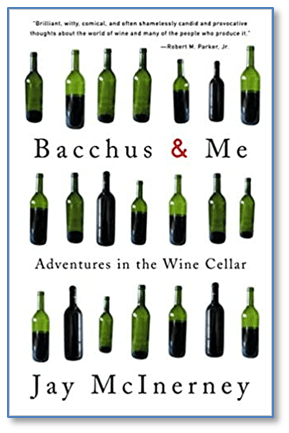
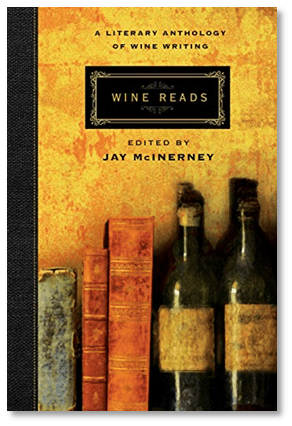
Wine book recommendation: We have two books about wine by the same author – Jay McInerney, most famous for the novel Bright Lights, Big City, who is also a dedicated wine lover. The first is Bacchus & Me: Adventures in the Wine Cellar, a collection of his wine reviews and columns he produced over several years. The second is Wine Reads: A Literary Anthology of Wine Writing, a collection of 27 articles on wine that he edited by brilliant writers from novels, memoirs, and nonfiction. I enjoyed both, as they really broadened my knowledge both of wine and wine lovers around the world.
 The Cellar Door
Love this write-up- sweet memories of yummy deliciousness 😋
Lisa A. Goodbee, P.E.
lisa@goodbeeassoc.com
http://www.goodbeeassoc.com
LikeLike