(Posted May 4, 2022)
This is the twelfth in a review of wines that were mentioned in the great book by Kermit Lynch, Adventures on the Wine Route: A Wine Lover’s Tour of France. Once again a reminder – Lynch’s book is by far one of the most enjoyable and informative books about wine you’ll read.
Happy Mother’s Day!
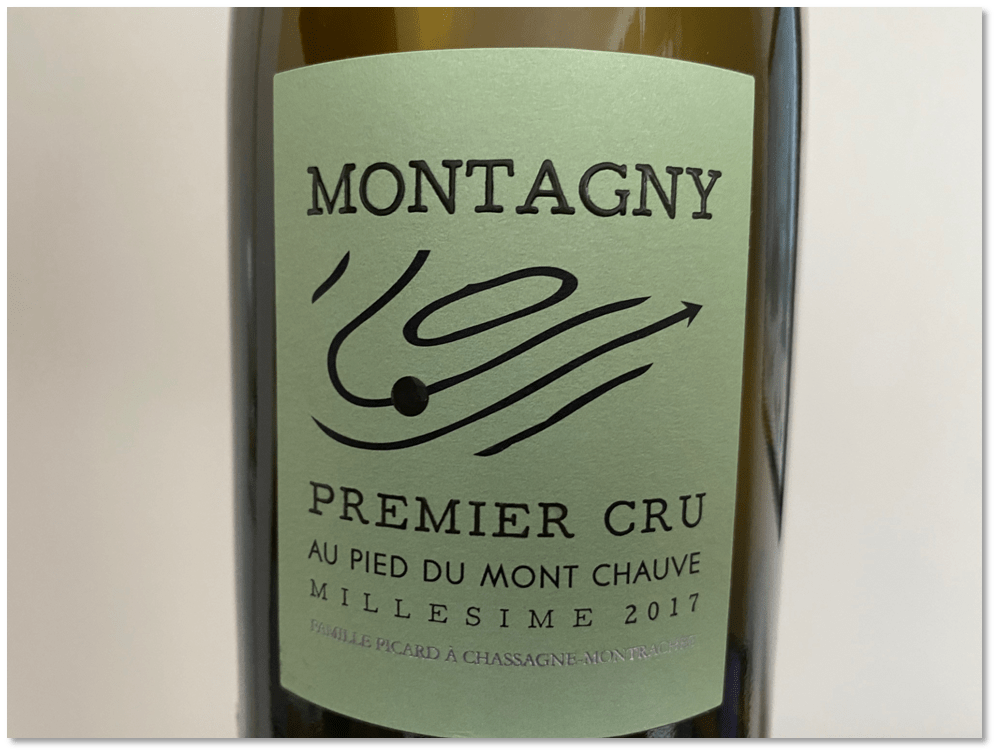
Our wine for this review is another great white wine from Burgundy – the Au Pied Du Mont Chauve Montagny Premier Cru from the Côte Chalonnaise subregion. About Montagny, Kermit Lynch writes:
I have developed a soft spot for the wines of the Chalonnais [note that the subregion can also be spelled this way], particularly the Montagny blanc…. How many people might, like myself, finish by uncorking many more bottles of Chalonnais whites than the bigger, more serious whites of the Côte d’Or…. Montagny does not and should not try to taste like Merusault [a wine we’ll be reviewing in the future]. It has its own charm, thank goodness.
Like Aligoté, which we reviewed previously, Montagny is grown in one small area within the Côte Chalonnaise, the “middle” subregion of Burgundy. The Oxford Companion to Wine tells us that the area “gets its name from the town of Chalon-sur-Saône, which had been an important Celtic trading centre in Ancient Gaul.” The World Atlas of Wine says that the terroir in this area is “green farming country with some limestone-dominated vineyards.” Montagny is exclusively chardonnay, the most widely grown grape in Burgundy (comprising about 46% of all grapes grown in the region – a reminder that all Burgundy wines are 100% of one grape, with no blending allowed), and comes from four communes in the subregion. Vins de Bourgogne tells us that the Montagny appellation includes 49 Premier Cru vineyards (we learned earlier that Premier Cru is the second-highest-quality designation in Burgundy, outranked only by Grand Cru).
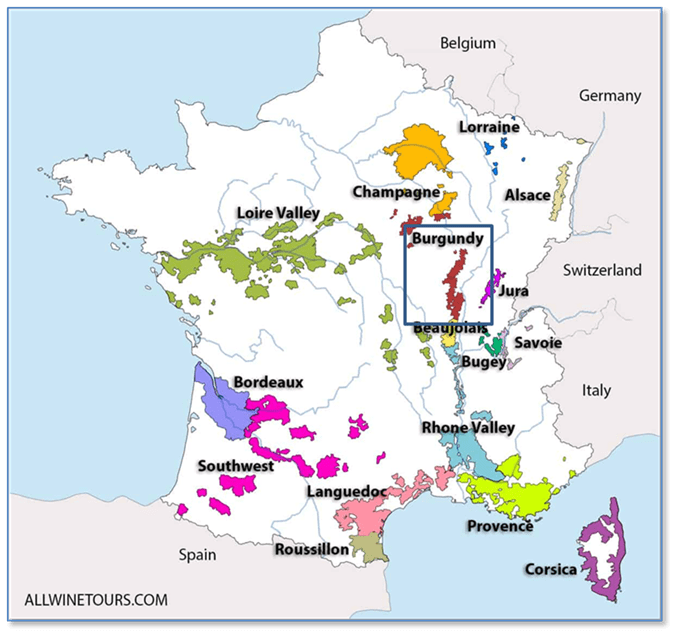

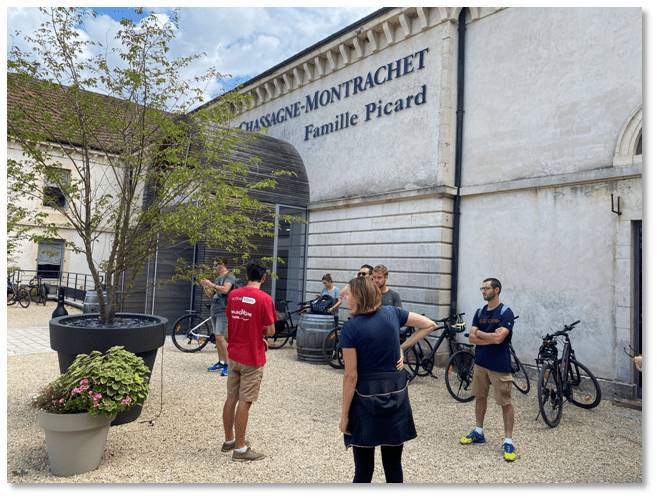
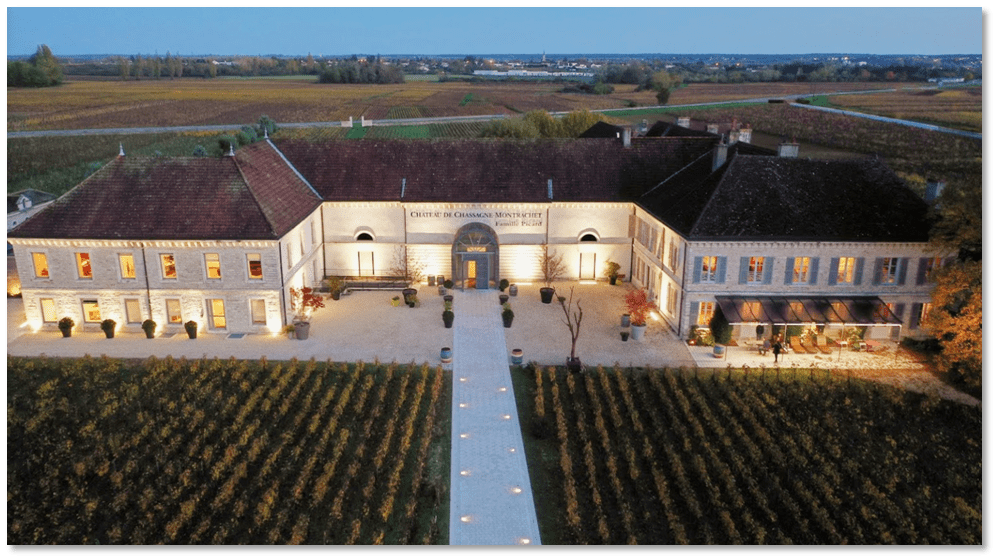
One interesting note – while the chardonnay grapes used in our wine came from Montagny in the Côte Chalonnaise, the wine itself was bottled at the lovely Château de Chassagne-Montrachet in Côte de Beaune to the north – which we visited in our bicycle tour of the region in the fall of 2021.
Apparently, the Côte Chalonnaise is the Rodney Dangerfield of Burgundy – it doesn’t usually get a lot of respect. About wines from the subregion, Eric Asimov of The New York Times wrote:
So close, and yet so far away. I sometimes wonder how it feels to be a vigneron in the Côte Chalonnaise, the hilly region that extends south and slightly east of the southern tip of the Côte d’Or, the great heart of Burgundy. The Côte d’Or, of course, receives all the accolades, the fawning visits and the money. The Côte Chalonnaise receives the figurative back of the hand because, well, it just isn’t the Côte d’Or…. the wines from the main villages of the Côte Chalonnaise – Bouzeron, Rully, Mercurey, Givry and Montagny – have always been considered the poor rustic relations, without the elegance, grace or delineated intensity of their betters.
Along those same lines, Dave McIntyre of The Washington Post wrote: “The villages here — Rully, Givry, Mercurey, Montagny and Bouzeron are the main ones — are peasants compared with the royalty to the north. And yet, they offer terrific wines for the price.” Peasants! And The World Atlas of Wine says the subregion’s wines taste “so perceptively different” from those in the Côte d’Or that they are “like slightly undernourished country cousins.”
So what were we to expect? Kermit Lynch again: “How tempting Montagny sounds when described by the French write Pierre Brejoux in Les Vins de Bourgogne: ‘Their golden green color, their fine bouquet, their taste of hazelnut, and their lightness, so appreciated in a white wine, make them seductive wines which go down easily and leave you clearheaded.’”
Vins de Bourgogne says this about Montagny:
To the eye, these wines present the classic features of a burgundian Chardonnay: limpid, pale gold colour with green highlights when young, darker gold colour with age. Their aromas are acacia, mayflower, honeysuckle, bramble flowers, and sometimes violet and bracken. Of the livelier scents, lemon-balm and gun-flint may be added. Hazelnut, white peach and ripe pear would not be surprising, either. In the mouth, the wine is always fresh, young at heart, frisky, alluring, and rich in spicy back-flavours. Refinement and delicacy are harmoniously matched to a durably well-built structure.
Wine Searcher tells us, “Montagny wines are identified by the fact that they have a little more body and slightly higher acidity than the whites from other Chalonnaise appellations. This is the result of Montagny’s marginally warmer southerly location and the high level of limestone in the local soils, which also brings a valued minerality to the wines.” Wine Enthusiast was enthusiastic: “A rich and softly textured wine, this is generous and opulent. White fruits and rich yellow and white stone fruits are bold and right up front.” And The Wine Bible had high praise: “Many Burgundy insiders consider Montagnys the best value white Burgundies going.”
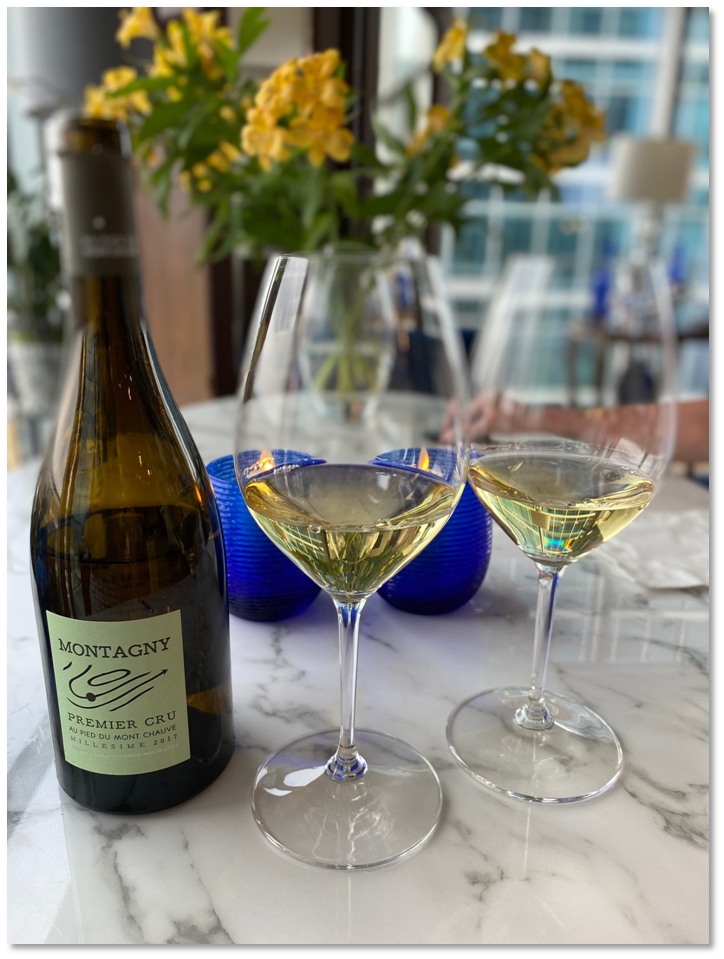
What was our experience? Another great Burgundy white – I mean seriously, how bad could it be? Our wine was a 2017 vintage (apparently a good year based on the reviews I saw) and had relatively high alcohol content at 13.5%. It had a lovely light golden color with a hint of green. We had lovely aromas of green apple and pear initially, changing to a more flinty or mineral aroma as it opened up. It had tastes of apple, vanilla and honeysuckle. My guest taster (Lisa) said it had a medium light buttery texture and taste (much lighter than the California chardonnays she is used to). It was complex with a “crisp, clean finish” and was “fruity in a good way, not in a sweet gross way!”
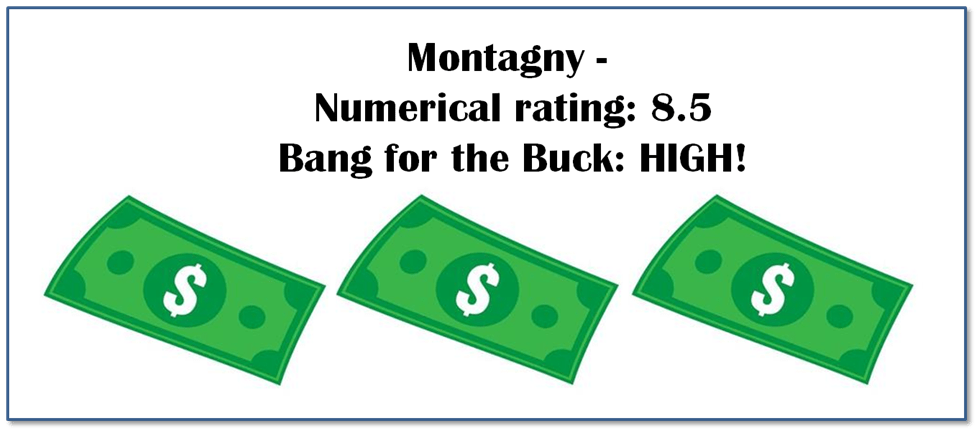
So what was the verdict? On a scale of 1 to 10, this would have to be an 8.5 at least, on the strictly subjective numerical scale (similar to other Burgundy whites we’ve tried). But what about the Bang for the Buck? Our Montagny was available at Total for $25, but you can find other well-regarded ones at around $20 or even less at most wine stores. So on the “bang for the buck” scale, this was definitely HIGH!!
Experience reminder: One other note – as we try more and more wines from France after our big tour of wine regions there in the fall of 2021, our tastings become more related to our experiences there – more so than purely qualitative ratings could ever impart. For example, I recently had a nice red wine I had never had before from the Puglia area of Italy (the boot heel area in the south of the country). It was a very dark red – almost purple – with very strong aromas and tastes that I had never had before. And after reading up on it, I could visualize the warm hilly slopes of southern Italy causing those strong aromas and tastes. In the case of the Montagny – and all the Burgundy wines we’ve had – we were able to remember our wonderful tour of Burgundy winemakers and vineyards.
Terry Theise wrote similarly about this in his wonderful book Reading Between the Wines, which we recommended in an earlier post. I’ll let him tell it his way:
If you are aware of the world, things will come to your attention. One of them is beauty, and one of the beautiful things is wine. But wine’s abilities do not stop at mere sensual beauty. Wine is able to channel multiple currents of beauty, from the pretty to the charming, from the fleeting to the logical, from the passionate to the pensive. And great wine will take you to a question and, wonderfully, deposit you there, without an answer or a map – just looking at the question…. A few great wines have seemed to dilate the world so that I seem to experience a collective memory. I might smell an old Loire valley Chenin Blanc, and it makes me think of an armoire. That’s not too fanciful. But it makes me think of an armoire in a room in a French country house, and I can see other furniture too, and the view of gardens and fields out the window, and I can almost hear the voices of the people who live in the house…. I sense an endless succession of brief lives, of people trying to work, and love, and be safe, and understand what it all means, and I am further away than ever from what it all means, but there is within it all a tremendous gravity, tenderness, and sadness for our strange species so heedless and so angelic…. I return to the wine in my glass. What I just described took place in a second or two. I haven’t figured out how to summon it, but I try to be there when it summons me. It means well by me.
I could never be so eloquent, but I would urge you to think about the wine you are drinking and where it came from and who grew it and who cut the grapes and who bottled it and how it got to your table. I think we can do this with wine at any level – from the $10 bottle of California chardonnay to the $50 bottle from Burgundy or Bordeaux. Visualize its legacy, its story, and I promise you that you will enjoy it that much more.
Book recommendation: One of my favorite books about wine in the past few years is Cork Dork: A Wine-Fueled Adventure Among the Obsessive Sommeliers, Big Bottle Hunters, and Rogue Scientists Who Taught Me to Live for Taste, by Bianca Bosker. As noted on her website, “With boundless curiosity, humor, and a healthy dose of skepticism, Bosker takes the reader inside underground tasting groups, exclusive New York City restaurants, California mass-market wine factories, and even a neuroscientist’s fMRI machine as she attempts to answer the most nagging question of all: What’s the big deal about wine? What she learns will change the way you drink wine–and, perhaps, the way you live–forever.” I enjoyed it so much that I visited a wine bar in New York City – called Terroir – where she formerly worked to visualize some of her adventures learning about wine (alas, she wasn’t working there anymore).

 The Cellar Door