(Posted August 21, 2022)
“Wine can of their wits the wise beguile, make the sage frolic, and the serious smile.”
― Homer
We’re taking a break from our one-by-one tastings of the wines mentioned in Kermit Lynch’s Adventures on the Wine Route: A Wine Lover’s Tour of France. Instead, we spent a few weeks in Italy tasting as many wines as possible.
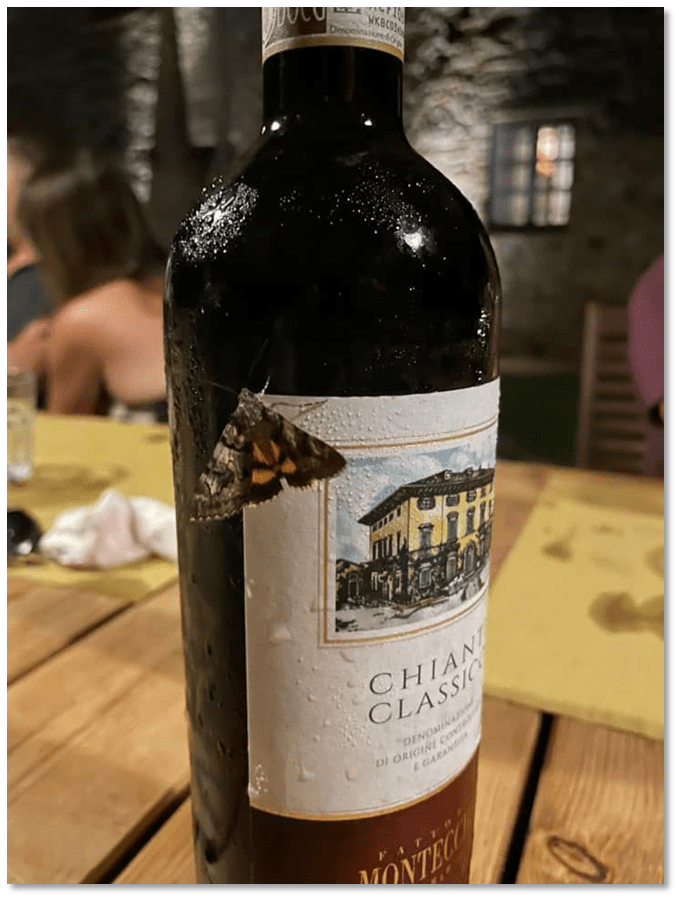
We spent all of July in Italy – being retired, we are extremely lucky to take this much time in a place we love. This was my third trip to Italy and by far the best. We were lucky to spend a week at a villa in the Chianti Classico region of Tuscany with a total of 21 people (friends and family members), then several days each in Lucca (also in Tuscany), Cinque Terre, Milan, and Lake Como. We always tried to sample the local wines in each of the areas we visited as we wanted to learn about (and taste) as many wines as possible. So I thought I would recap many of the wines we had so that you might try them too.
Tuscany
Well let’s start with arguably the most famous Italian wine region of all – Tuscany, or Toscana. The Oxford Companion to Wine says that it is “the most important region in Central Italy… it is the region which formed Italy’s language, its literature, and its art, and has thus assumed a central place in the country’s culture and self-image.” The handy little book Decoding Italian Wine tells us that Toscana is “probably the most universally recognized region of Italian wines” and “is also one of the oldest wine-producing regions in the world.”
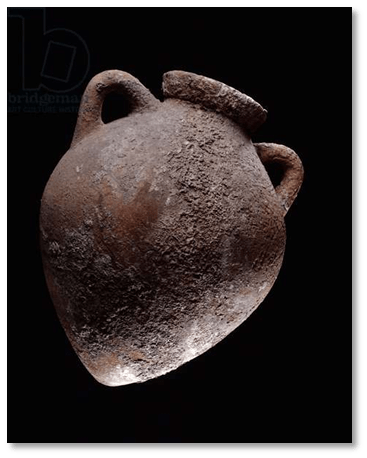
It appears, based on expert analysis of early cave drawings and pottery markings, that winemaking in Tuscany began as early as the 4th century BC when the area was first inhabited by the Etruscans. Back then, it’s believed that Sangiovese grapes grew in the wild, and the Etruscans began creating wine with them.
Wine Trails tells us that the Etruscans used “huge terracotta amphorae that are today being rediscovered by certain natural winemakers.”
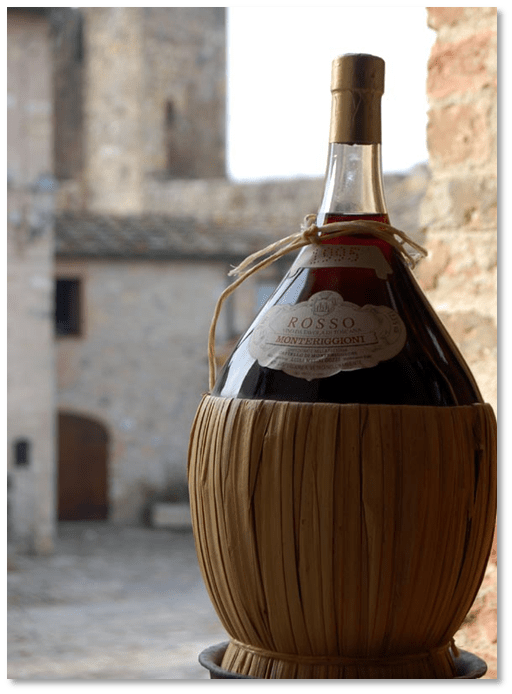
As early as the 5th century BC [4th century BC, 5th century BC, what’s a century or two among friends?], Tuscan wines were exported to France and Greece, and Florence founded its own Wine Merchants Guild as early as 1282. So Tuscany has always been the ambassador of Italian wine, from ancient times through to the days when the eponymous straw-covered flask of Chianti became the house wine of every pizzeria in the world.
The Wine Bible tells us that Toscana “stretches from the Tyrrhenian Sea in the west to the low mountains that separate the region from Emilia-Romagna, the Marches, and Umbria, its neighbors in the east. At 9,000 square miles, it is the fifth largest region in Italy.”
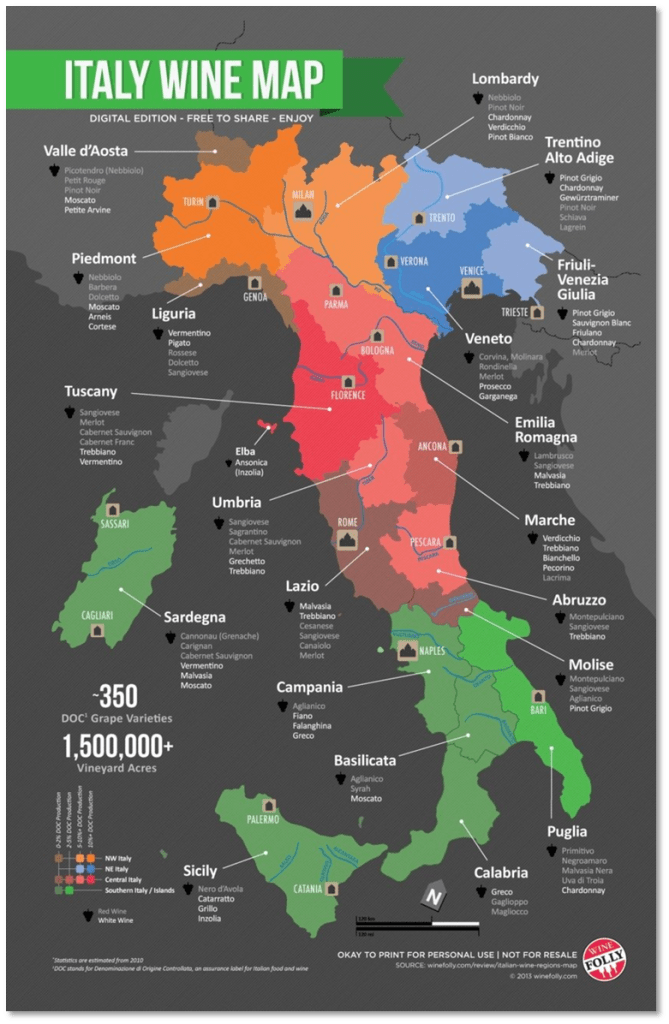
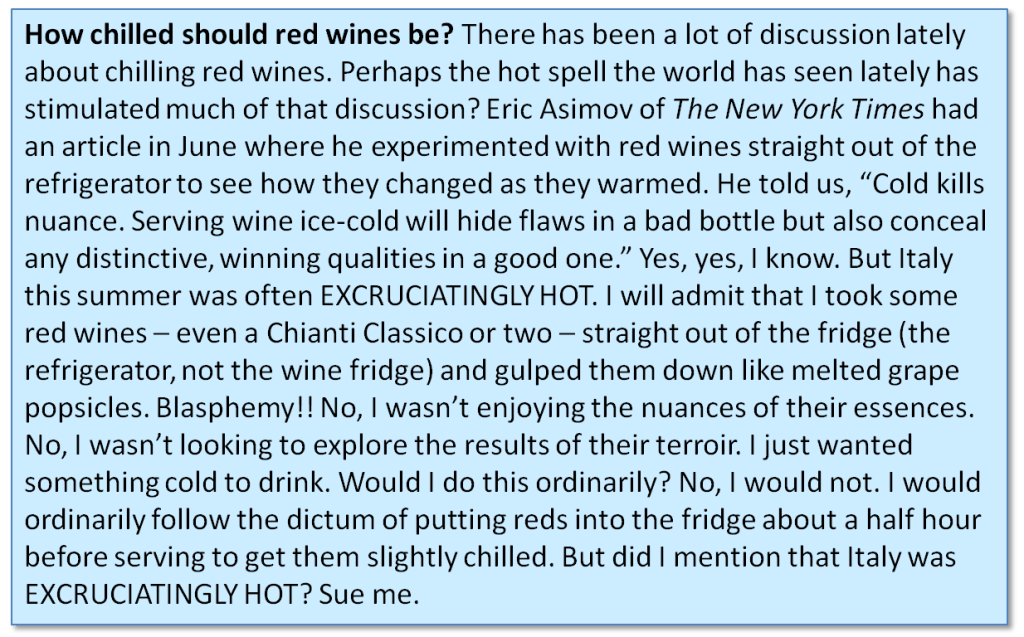
We were in two locations in Tuscany. The first was near the village of Poggibonsi, about 30 miles south of Florence. It is on the far western edge of the Chianti Classico zone. The Chianti region itself encompasses a large area between Florence and Siena. There are several sub-zones in Chianti, with the separate Chianti Classico zone comprising the heart of the area.
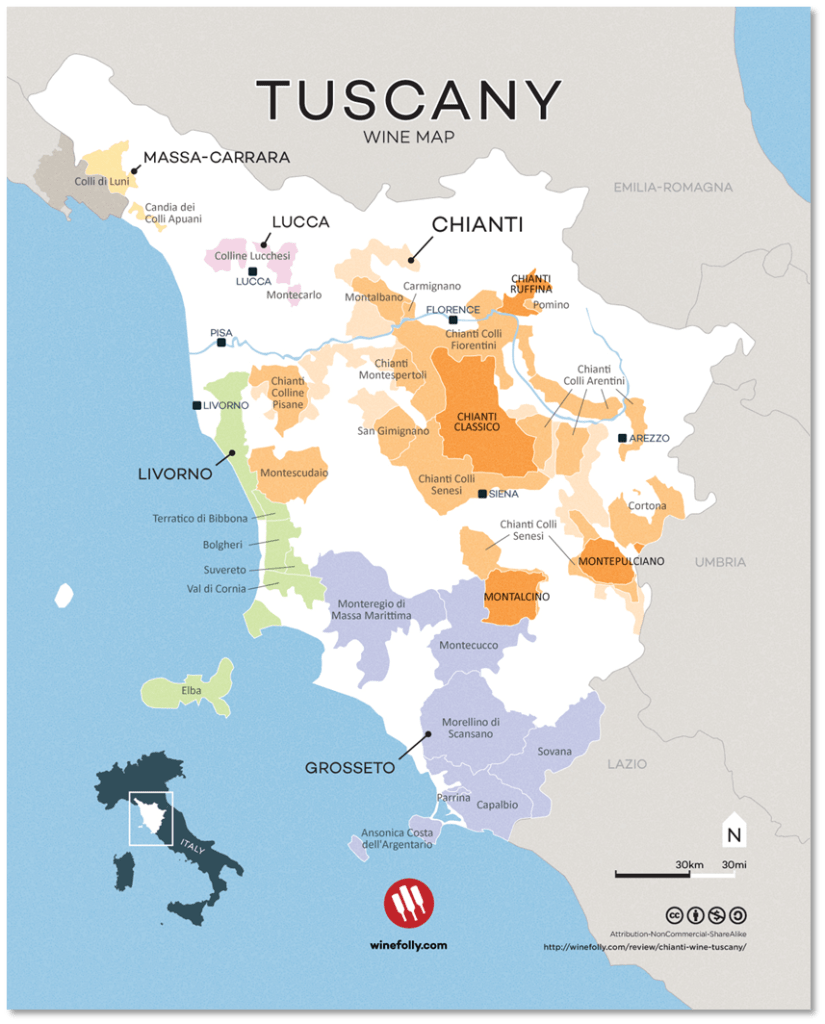
Wine Enthusiast tells us that “Chianti Classico must contain at least 80% Sangiovese. A maximum of 20% of other red grapes Colorino, Canaiolo Nero, Cabernet Sauvignon and Merlot may be used…. There are three quality tiers in the appellation. Annata, or the standard wine, ages for 12 months before release, while Riserva must age 24 months. Gran Selezione has the longest aging requirement at 30 months.”
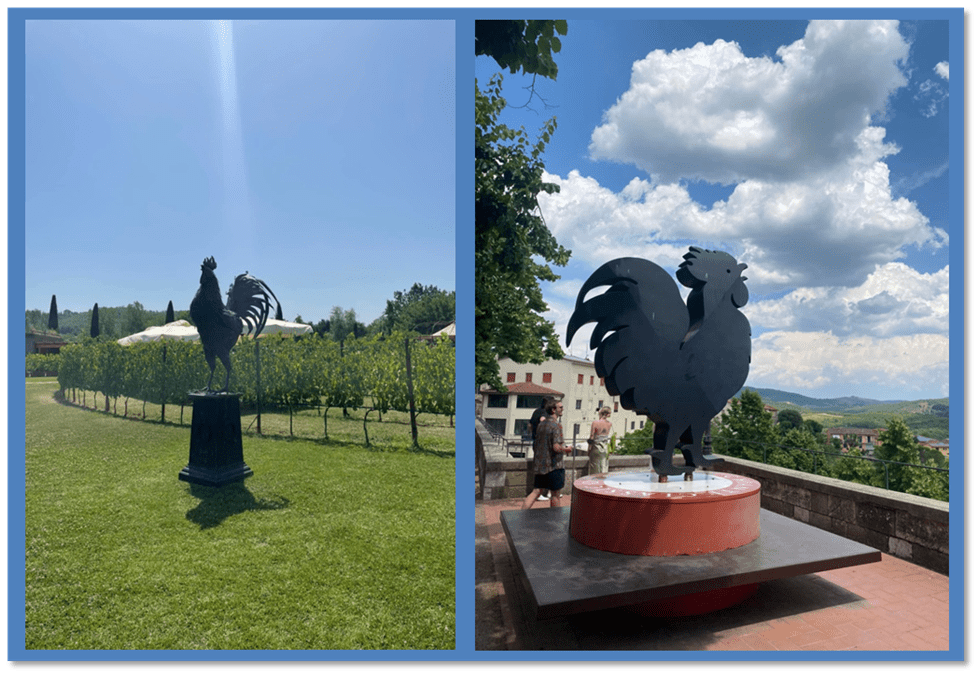
Wine Enthusiast also tells us that “The emblem of Chianti Classico is the black rooster, or gallo nero. It relates to a legend told about the use of roosters to settle a border dispute between the warring provinces of Sienna and Florence. The black cockerel was the symbol of Florence, while the white cockerel represented Sienna. It’s clear who dominated that contest.” We saw a bunch of black rooster statues at wineries in the area.
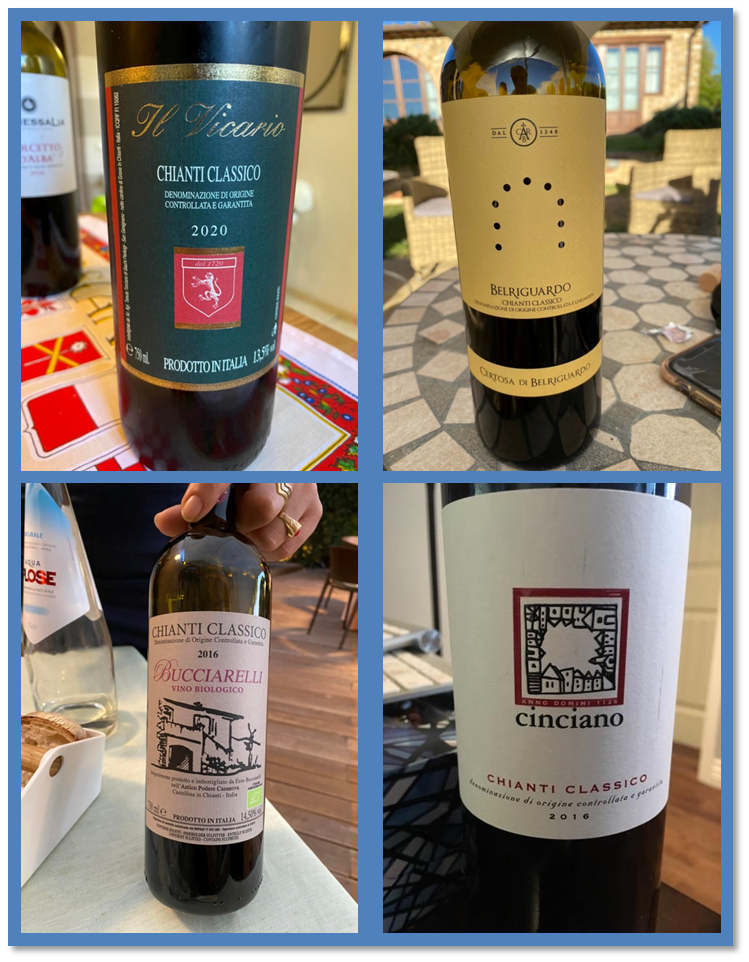
So what were the wines we tried in the Chianto Classico region? Well, we tried several Classicos, including:
- Il Vicario from Torciano winery (a large wine/restaurant empire near San Gimignano) – 100% Sangiovese;
- one from Belriguardo, a winery on the far southern end of the region, about 10 miles south of Poggibonsi – 95% Sangiovese and 5% Merlot;
- one from Bucciarelli, about 10 miles east of Poggibonsi – 100% Sangiovese; and
- one from Cinciano, a lovely winery/hotel/restaurant complex just up the road from us – 100% Sangiovese.
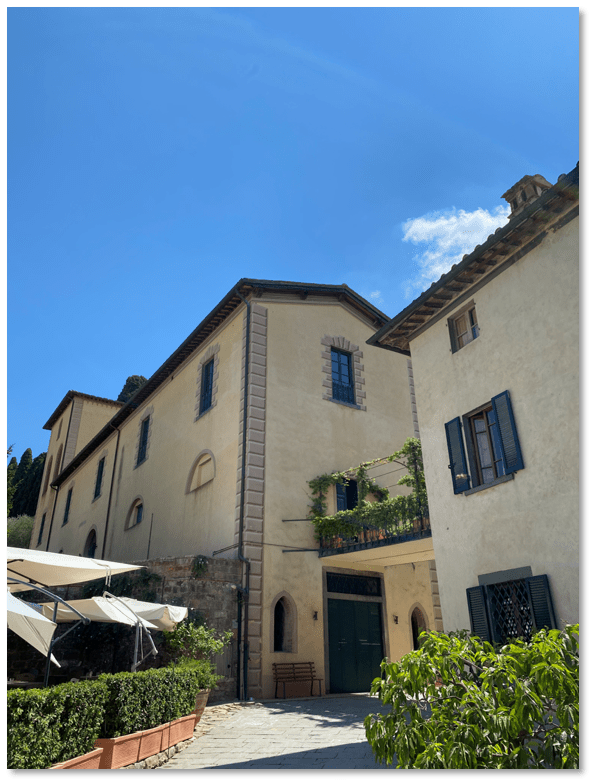
Cinciano’s restaurant is called Osteria 1126 – mainly because the original buildings have been there since the year 1126. It was a magical place – highly recommended if you’re ever in the area.
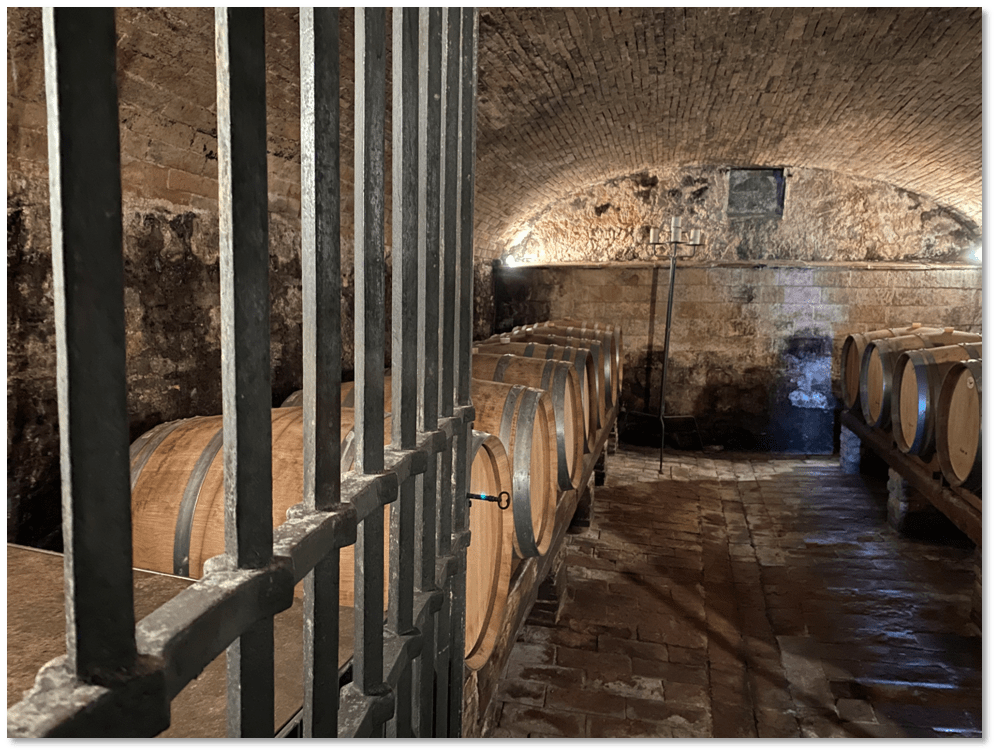
Our take on Chianti Classico? All of them were delicious. Sangiovese is a rich, red grape full of fruit flavors, mainly cherries and plum, and it was outstanding in all its iterations. Of course, it helped that we were in the Chianti Classico region, but they were wonderful nevertheless. We liked them all, but we especially liked the Cinciano, as we were able to visit the winery and see how it was made.
What about white wines from Tuscany? Tuscan whites don’t get as much press as the reds, but there are some outstanding whites to try. Two in particular stood out.
Vernaccia is one of my favorite whites from the region, for a lot of reasons. First of all, it’s delicious, with bright crisp flavors, and is readily available at most wine stores in the US. Second, it’s from the magical medieval town of San Gimignano (about 15 miles west of where we were staying near Poggibonsi). Wines of the World tells us that this wine has been around since at least 1276 (!) and “has the longest pedigree of any white varietal wine in Italy.” One we tried was from the Cecchi vineyards. It had the added bonus of having a lovely label with the towers of San Gimignano silhouetted.
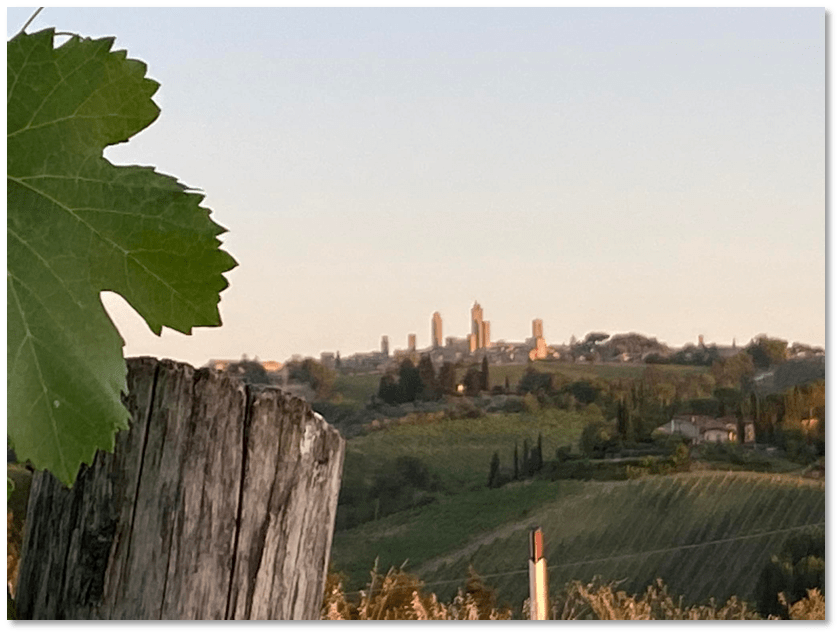
The second white wine we spent some time with in Tuscany was Vermentino. These wines come mainly from the island of Sardinia, but the grapes are being planted more and more throughout Italy. Similar to Vernaccia, the Vermentino wines were light and crisp, perfect for the hot summer days we had in Italy. One we tried was from Antinori vineyards; this one was from the Bolgheri area on the far western portion of Tuscany along the coast.
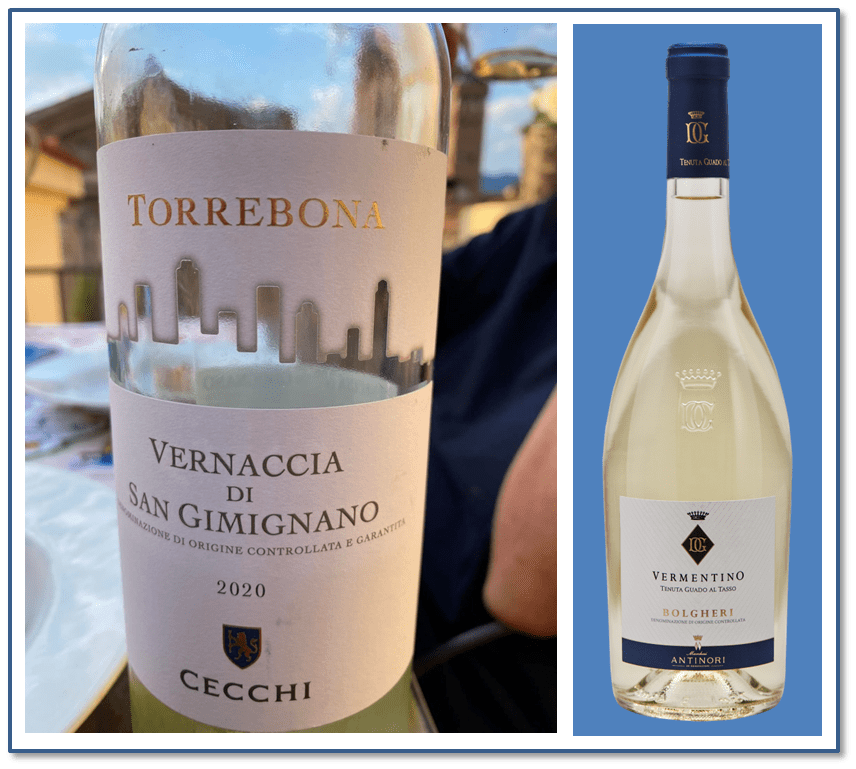
Our second stop in Tuscany was the walled medieval town of Lucca, about 50 miles west of Florence. There were two wonderful whites we tried there.
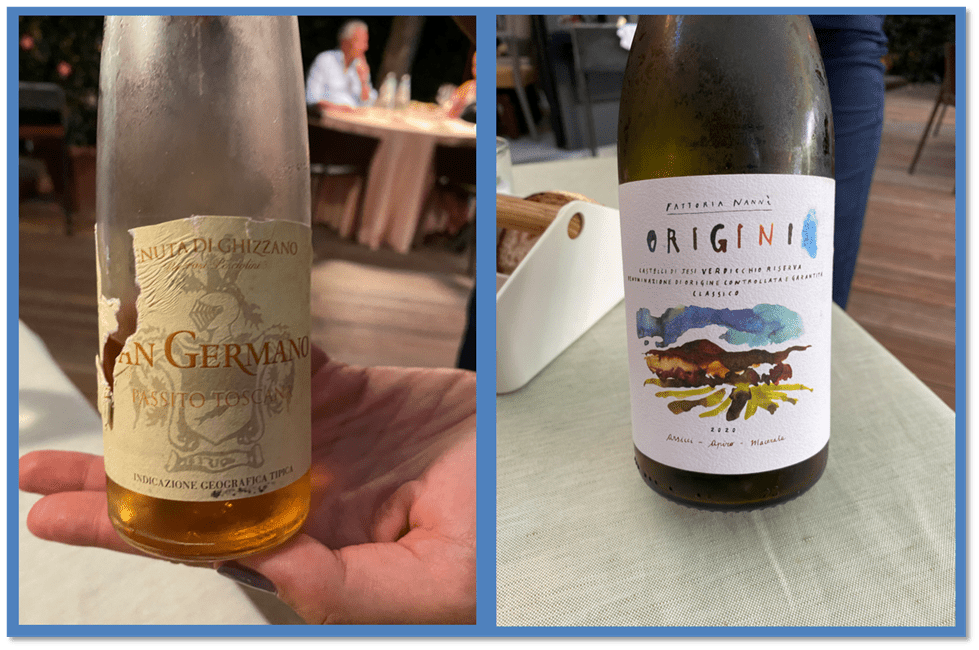
San Germano Passito Toscana is from the Tenuta di Ghizzano winery, an organic winery about 20 miles southwest of Lucca, near Pisa (the word “tenuta” means “estate”). It was comprised of a wonderful blend of 80% Trebbiano along with Colombana Nera and Malvasia grapes. According to Decoding Italian Wine, Trebbiano is the “second most widely planted grape in the world and is used in more than a quarter of Italy’s” primary wines, yet it “flies under the radar” because “it’s most commonly employed as a blending component, and its moniker rarely appears on labels.” Fun fact: “Trebbiano grapes are also used to produce balsamic vinegar. During the course of aging and fermentation over many years, the Trebbiano grape juice syrup gradually turns its trademark dark brown color and develops the unique balsamic vinegar flavor loved by many.” Who knew?
Another white we liked while in Lucca was Fattoria Nanni Origini Verdicchio. In addition to having a wonderful colorful label, it was also from a region we hadn’t experienced before: the Marche. This region is to the east of Tuscany and runs to the Adriatic Sea. Verdicchio, according to The Oxford Companion, is “one of central Italy’s classic white wines….the best wines are cool with minerally mandarin fruit, lifted lemony acidity, and a slight chew on the finish.” Very detailed description!
Cinque Terre
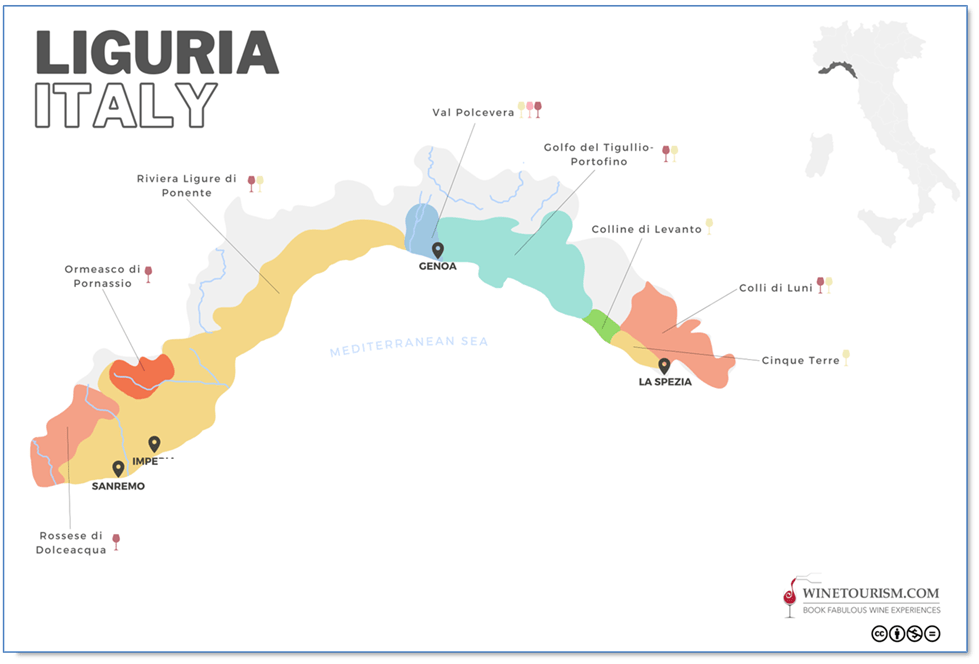
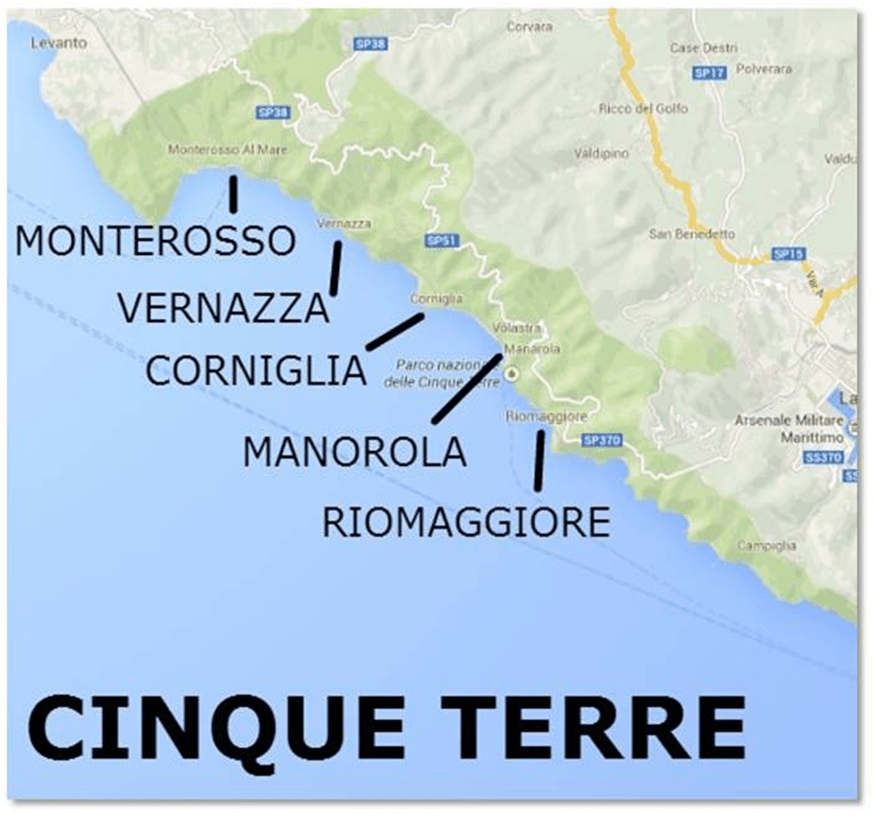
Our next stop was in the far northwest corner of Italy, in the Liguria region. You might say it’s the top of the sock of the boot of Italy. We stayed in the Cinque Terre zone, on the far eastern part of the region. Cinque Terre means “five lands,” and it’s comprised of five former fishing villages that have become tourist meccas in the last 50 years (thanks to new roads and better rail service). It’s often described as Italy’s Riviera. Our base of operations was Monterosso del Mare, the northernmost (and largest) town of the five.
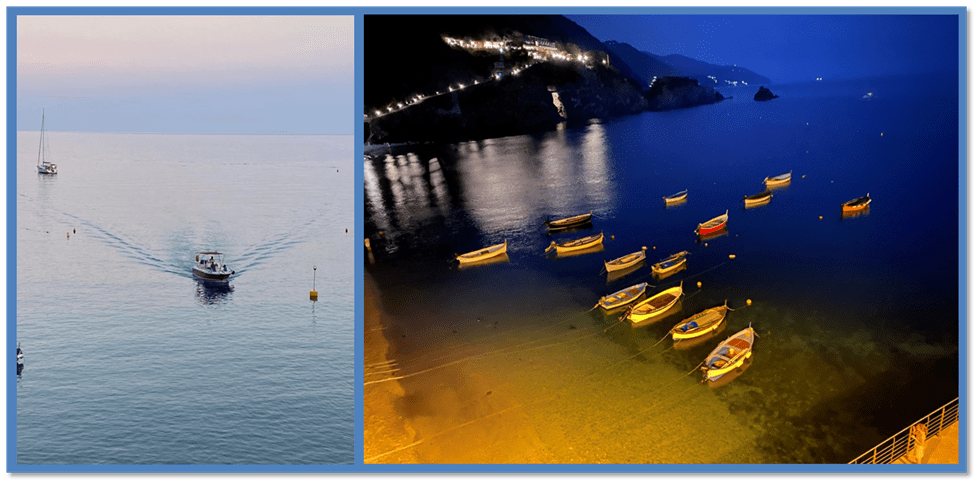
To say that Monterosso (and all of Cinque Terre) is picturesque is an understatement. It was spectacularly beautiful, and we were lucky enough to stay in a rental near the harbor with absolutely wonderful views of boats, people, and stunning sunrises, sunsets, and the harbor at night.
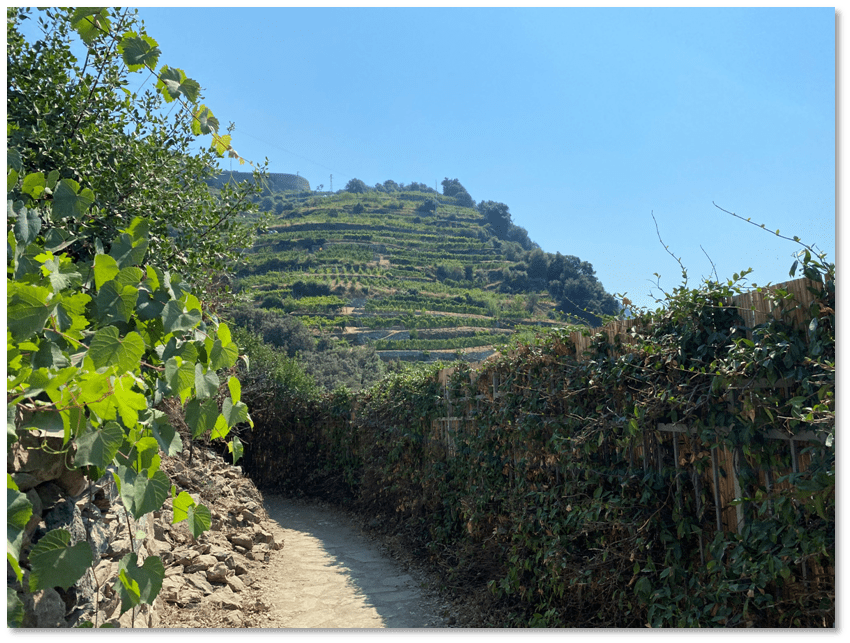
Liguria is the second-smallest wine-producing region in Italy, with most of the vineyards lying on the region’s steep, rocky hills.
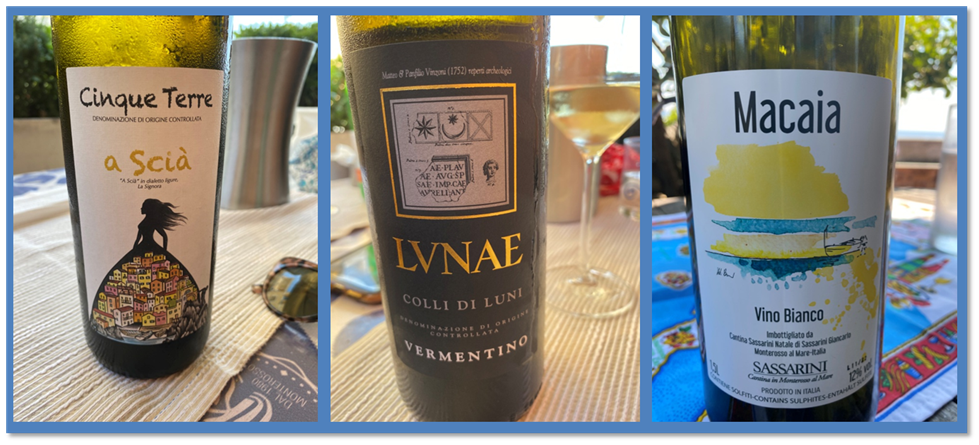
Our first wines in the region were three nice whites:
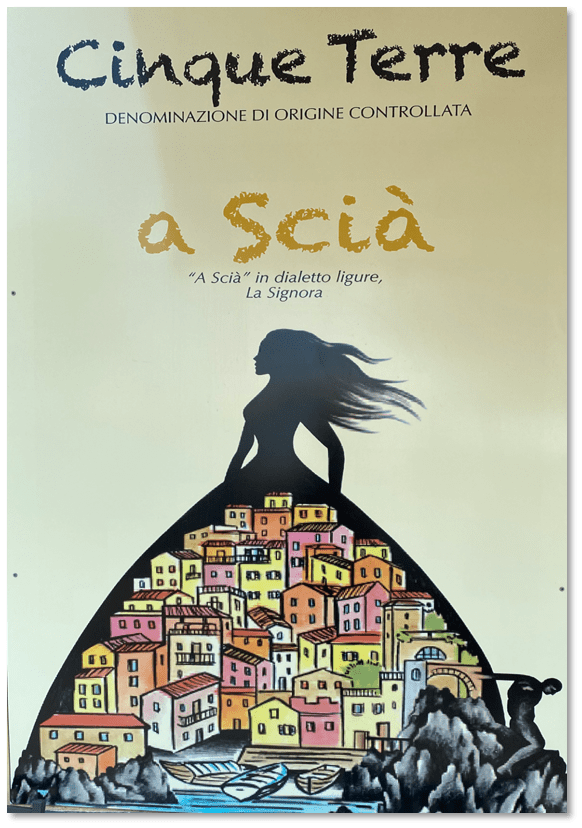
- a Scià, a wonderful wine made of Vermentino along with Bosco and Albarola grapes, aged about seven months (and with possibly the best label I’ve ever seen);
- Lvnae Colli di Luna Vermentino. The winery’s website says that “The name Lvnae is inspired by the town of Luni, an ancient Etruscan and Greek port, consecrated to the goddess Selene by the Greeks (Luna, for the Romans). The first Luna settlement was founded by the Romans in 177 BC.” Quite the pedigree; and
- Macaia Sassarini, a local Monterosso wine, with Vermentino grapes.
You may notice the preponderance of Vermentino grapes in these local wines. As noted earlier, Vermentino is prominent on Sardinia and (to a lesser extent) in Tuscany. But an article in Forbes Magazine had high praises for these locally produced vintages: “producing a Vermentino from seaside vineyards gives the wines a special character that you don’t find from a warmer, inland area. Vermentino from a maritime climate tends to display a minerality or saltiness in the finish – as though you are tasting the soils and/or experiencing the tanginess of the sea when you are enjoying the wine.”
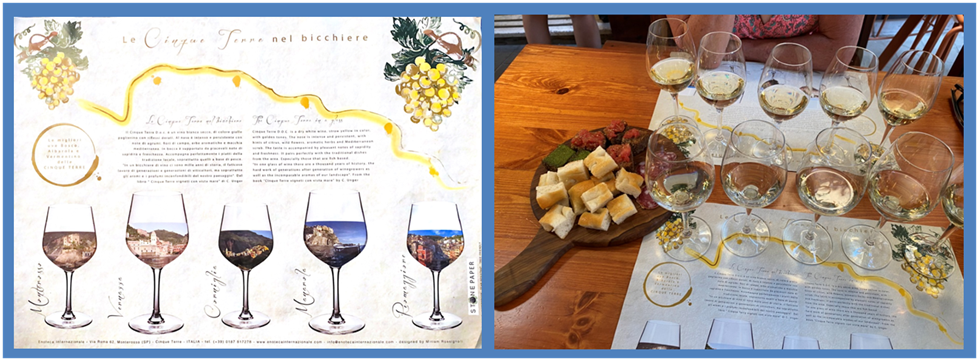
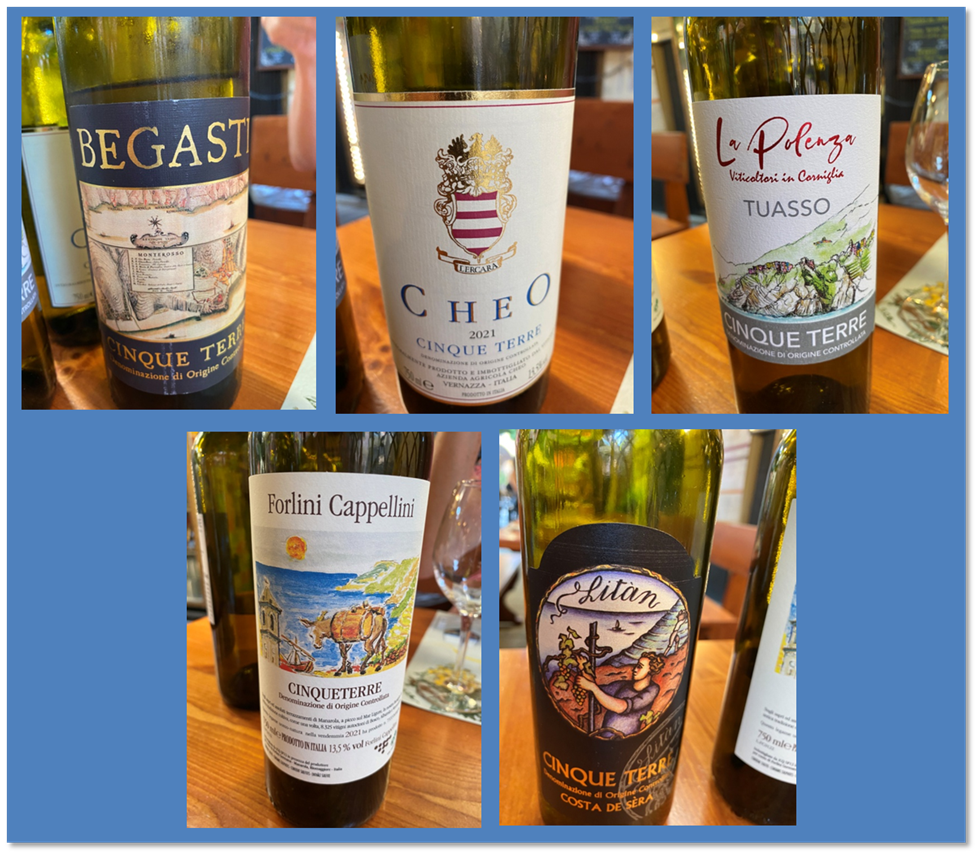
Our next wine adventure was at a nice little bistro in Monterosso called Enoteca Internazionale. It featured a tasting of five different wines from – you guessed it – the five towns of Cinque Terre. The five were:
- Begasti from our home base Monterosso;
- Cheo from Vernazza;
- La Polenza from Corniglia;
- Forlini Cappellini from Manarola; and
- LItan from Riomaggiore.
All five had roughly the same blend of Vermentino, Bosco, and Albarola grapes. Our challenge was to sample all five to determine how each was subtly different based on the specific conditions of each vineyard – sun, soil, verticality, precipitation. They were all wonderful, but we were partial to our “hometown” wine from Begasti. And we got to keep a cool souvenir placemat too.
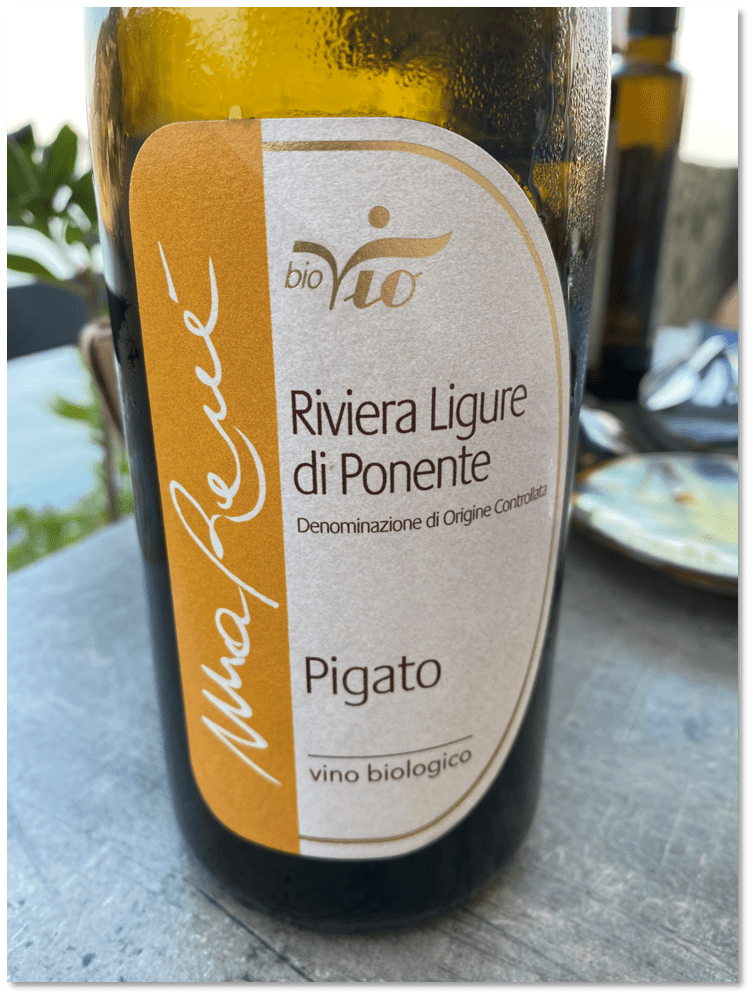
Finally, I made sure we were able to try one type of local wine we hadn’t had before – Pigato. The Italian Wine Guide tells us that Pigato is genetically identical to Vermentino, but it “nevertheless achieves unique expression: pigato favors the earthy side of the flavor spectrum, is a bit more acidic and has a touch more body weight… in addition, pigato is inclined to have more pronounced saline notes, making it ideal for local seafood and shellfish.” Yes, we had it with a lovely main course of fish at the Torre Aurora restaurant in Monterosso.
Lombardy
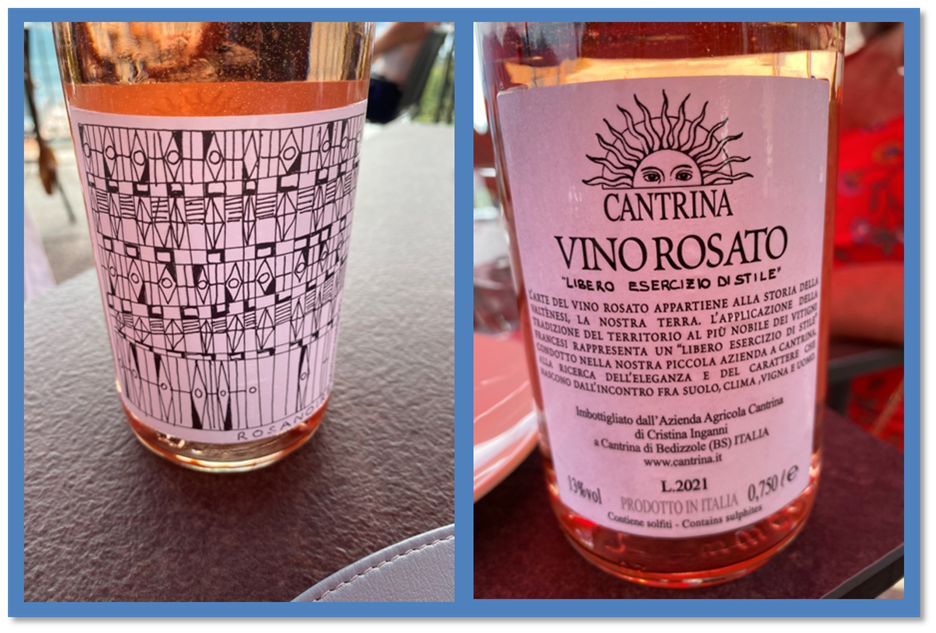
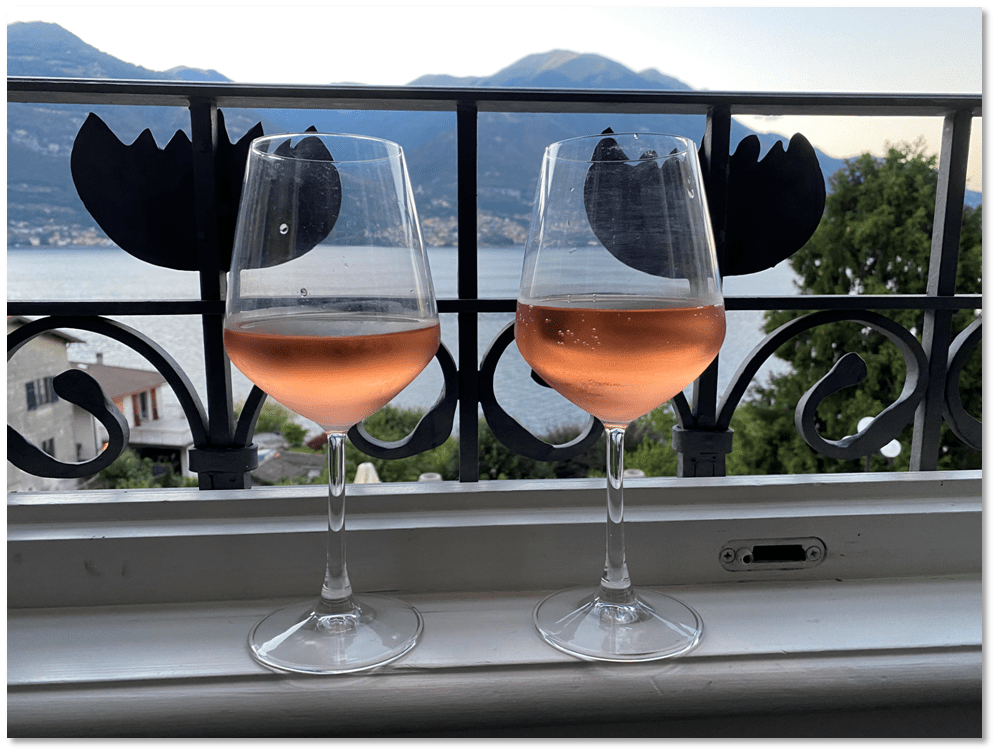
Our last region in Italy that we explored was Lombardy, in the north central portion of Italy along the border with Switzerland. We visited Milan and Lake Como, and both exposed us to wonderful wines. One of our best experiences was a nice rosé from Cantrina vineyards in Beddizole, in the eastern portion of the region. It was made from Pinot Noir grapes and was delightfully refreshing. We had it at a hilltop restaurant in the town of Bellagio on Lake Como. And of course, it had a great label (did I tell you I am a sucker for cool labels?).
Perhaps the most common white wine in Lombardy is Lugana. The Italian Wine Guide tells us that Lugana wines are comprised of “a minimum of 90% Trebbiano [grapes]. Trebbiano-based wines deliver light, crisp green fruits with a touch of chalky minerality and bitter almond.” We had this one several times, primarily at Lake Como, and it was our go-to wine for most meals.
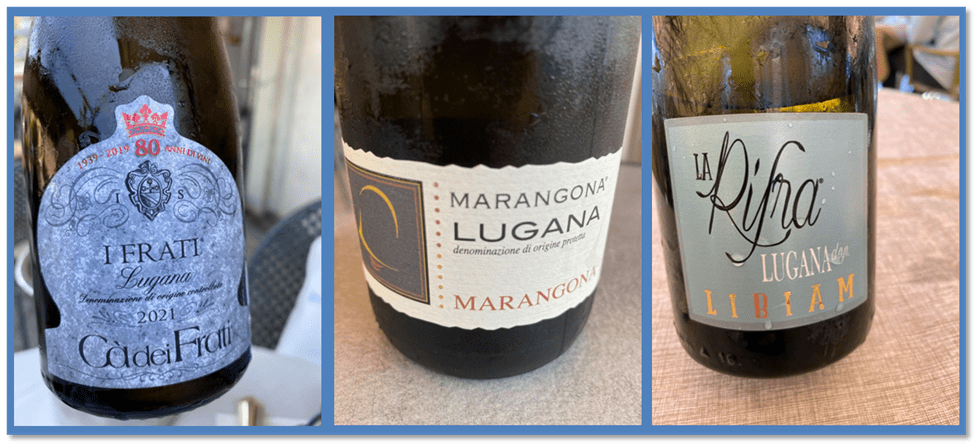
Three in particular we liked, all from vineyards just south of Lake Garda on the eastern border of Lombardy, and all 100% Trebbiano:
- I Frati, with a very elegant label (!), described on the vineyard’s website as “the jewel in the crown”;
- Marangona, from an organic winery; and
- La Rifra.
As noted earlier, Trebbiano is the second most widely planted grape in the world and is used in more than a quarter of Italy’s primary wines, yet it is often looked down upon as a run-of-the-mill grape. Wines of the World calls it a “fairly ordinary grape,” and the Italian Wine Guide says “Overall, it is a lackluster grape and usually makes disappointing neutral-tasting wines” but “At their best, they deliver subtle, crisp green fruits and a touch of chalky minerality with high levels of acidity.” We enjoyed our Luganas, and we thought it was especially refreshing on hot afternoons.
What About the Reds?
You may have noticed that most of the wines I mentioned were whites, other than the Chianti Classicos from Tuscany. Obviously, there are many, many great red wines from Italy – including my favorite, Brunello, along with Barolo, Barbera, Montepulciano d’Abruzzo, and many more. We tried a few, but honestly, given the extremely hot weather in Italy, we focused primarily on whites just because they were more refreshing on those hot days.
One of these days, I’m going to start reviewing a lot of Italian wines, so I’ll be sure to include my favorite reds, so stand by.
Conclusions and Observations
Overall, we were extremely pleased by the variety of wines we tried in Italy. If I could pick out two favorites, they would be:
- The Chianti Classico, with its wonderful dark and refreshing fruit taste; and
- A tie between the Vernaccia from San Gimignano and the a Scià Vermentino from Cinque Terre. Did I mention the latter had about the best label I’ve ever seen?
Ciao, salute, and cin cin!
 The Cellar Door
Loved it 😊
Sent from my iPhone
>
LikeLike